
Many children say funny versions of words while learning to talk. A 3-year-old may say wabbit for rabbit or tat for cat, and that can be part of normal development. Concern grows when speech remains hard to understand, certain sounds are always missing or a child becomes frustrated because others cannot understand them. A Speech Articulation Disorder means a child has difficulty producing specific speech sounds clearly and accurately for their age.
This guide explains what parents should know, including common signs, the causes of articulation disorders and treatment options that can improve clarity. If you are searching for Speech therapy Dubai, early assessment can help your child receive the right support before communication challenges affect school readiness and confidence.
Table of Contents
ToggleWhat Is a Speech Articulation Disorder?
A Speech Articulation Disorder is a type of speech sound disorder where a child struggles to form individual sounds using the lips, tongue, teeth, jaw, palate and breath. The child may understand language well and know exactly what they want to say, yet the sound does not come out correctly.
An articulation disorder is different from a phonological disorder. Articulation difficulty is usually about the physical production of sounds, such as lisping an s sound or substituting w for r. Phonological difficulty is about sound patterns, such as leaving off final sounds in many words. Some children have both, which is why a full assessment matters.
The American Speech-Language-Hearing Association explains that speech sound disorders can include problems with articulation and phonological processes. In everyday terms, this means your child may need help learning where to place their tongue, how to shape the mouth or how to use sounds correctly in words and conversation.
Why Clear Articulation Matters
Speech clarity is not only about pronunciation. When children are not understood, they may stop participating in classroom discussions, avoid asking questions or become upset during play. Over time, a Speech Articulation Disorder can affect social confidence, early literacy and the way a child sees themselves as a communicator.
Clear speech also supports reading and spelling. Children need to hear and produce sound differences to build phonological awareness, which is a foundation for literacy. For example, if a child cannot consistently hear or say the difference between top and cop, spelling patterns may become harder later.
Professional Speech therapy helps children practice speech sounds in a structured and motivating way. Therapy also teaches parents how to support progress at home without turning every conversation into a correction.
Common Causes of Articulation Disorders
The causes of articulation disorders can be simple or complex. Sometimes there is no single clear reason. In other cases, a speech therapist may identify hearing, oral motor, developmental or environmental factors that contribute to unclear speech.
Possible cause | How it may affect speech | What parents may notice |
Hearing difficulties | A child may not hear sound differences clearly | Mishearing words, delayed responses or frequent ear infections |
Oral motor weakness or coordination issues | The tongue, lips or jaw may not move accurately for some sounds | Drooling, difficulty imitating mouth movements or unclear consonants |
Dental or structural differences | Teeth, palate or jaw alignment may affect airflow and placement | Lisping, nasal speech or distorted sounds |
Developmental differences | Speech development may be affected by broader developmental needs | Delayed milestones, reduced imitation or difficulty with play communication |
Limited sound practice | Children may need more modeling and responsive interaction | Fewer attempts to speak, frustration or reliance on gestures |
Because the causes of articulation disorders differ from child to child, treatment should never be one-size-fits-all. A bilingual or multilingual child in Dubai may also show different sound patterns across languages. This does not automatically mean a disorder is present. A qualified clinician looks at all languages used by the child when possible.
Signs Parents Should Watch For
A Speech Articulation Disorder may look different depending on age and sound targets. Some speech errors are developmentally expected, but persistent patterns should be checked.
Common signs include:
- Leaving sounds out, such as saying ca for cat
- Replacing one sound with another, such as wabbit for rabbit
- Distorting sounds, such as a slushy or lisped s
- Being understood by close family but not by teachers or new people
- Avoiding talking because pronunciation feels difficult
- Showing frustration when asked to repeat words
- Difficulty with sounds that peers of the same age use clearly
A speech sound disorder may also show up during reading readiness activities. Children might struggle with rhyming, clapping syllables or identifying the first sound in words. If your child is frequently misunderstood after age 3 or 4, it is wise to seek professional guidance rather than wait and hope the issue disappears.
How a Speech Therapist Assesses Articulation
A detailed assessment is the first step. A speech therapist will usually begin with parent concerns, developmental history, hearing history and the languages spoken at home. The therapist then listens to your child during conversation and structured speech tasks.
The assessment may include checking how the lips, tongue, jaw and palate move. The therapist may test sounds at the beginning, middle and end of words. They may also check whether the child can produce a sound with cues. This is called stimulability and it helps predict which therapy targets may improve first.
For a suspected Speech Articulation Disorder, the goal is not simply to label the problem. The goal is to understand why the child is unclear, which sounds to target first and how therapy can fit into family life.
How Speech Therapy for Articulation Disorders Works
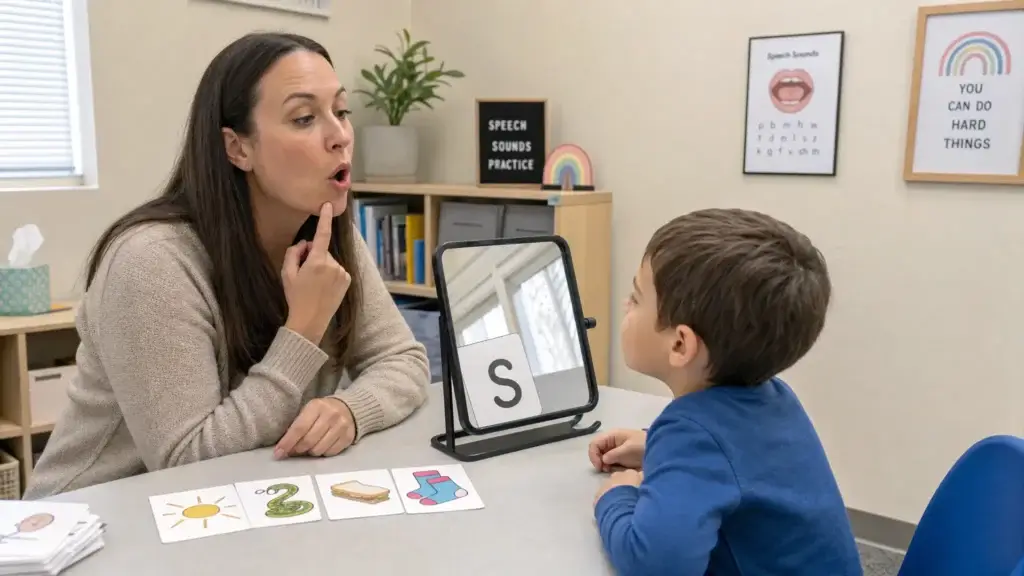
Speech therapy for articulation disorders is highly practical. Children practice specific sounds in a step-by-step way, moving from sound isolation to syllables, words, phrases, sentences and natural conversation. For example, a child may first learn how to place the tongue for the k sound, then practice key, car and cookie before using the sound during a story or game.
At Bridges, articulation speech therapy is designed around the child’s age, attention, interests and communication goals. A young child may learn through play-based routines. An older child may use self-monitoring tools, reading passages and conversation practice.
Treatment for Speech Articulation Disorder may include:
- Auditory discrimination so the child hears the difference between correct and incorrect sounds
- Placement cues that show where the tongue, lips and teeth should be
- Repetition in short, motivating activities
- Minimal pair practice for children who confuse sound contrasts
- Home practice plans that are realistic for busy families
- Generalization activities so clear speech carries over to school and daily life
Speech therapy for articulation disorders works best when practice is frequent but not stressful. Short daily practice is often better than one long session per week. The latest therapy trends focus on parent coaching, hybrid clinic and telehealth models, data-informed progress tracking and meaningful practice in real-life routines.
Practical Tips to Support Clearer Speech at Home
Parents can make a big difference, especially when practice feels playful. Start by listening to your child’s message before correcting the sound. Confidence matters. A child who feels heard is more likely to keep trying.
Try these simple strategies:
- Model the correct word naturally: If your child says wed car, you can respond yes, a red car
- Choose one target sound at a time instead of correcting every error
- Use a mirror so your child can see mouth placement
- Practice during routines like snack time, bath time and story time
- Praise effort and attention, not only perfect pronunciation
- Keep practice short, about 5 to 10 minutes
- Avoid asking your child to perform difficult sounds in front of visitors
At home, speech therapy for articulation disorders should feel like guided practice, not pressure. If your child resists, pause and ask your therapist how to adapt the task. Sometimes a mild articulation disorder needs only focused practice. Other children need a longer plan that addresses sound awareness, oral coordination and carryover into conversation.
When to Seek Professional Help in Dubai
Consider an assessment if your child is often hard to understand, avoids speaking, has sound errors that persist beyond the expected age or shows frustration during communication. You should also seek help if speech clarity worsens, if your child has a history of hearing concerns or if unclear speech appears alongside feeding, motor or developmental difficulties.
Families looking for local support can contact Bridges Speech Center for individualized care in a safe and supportive environment. The team provides therapy services for children and adults, including speech therapy, feeding therapy, occupational therapy, physiotherapy, psychology and parent training. For families who need flexible access, home care and telehealth options may also support consistency.
Choosing the right support matters. The best plan for a speech sound disorder should be clear, measurable and easy for parents to follow. Progress may be seen in therapy first, then at home, then in school and social settings.
Conclusion
A Speech Articulation Disorder can affect pronunciation, confidence and early learning, but children can make strong progress with the right support. The key is to identify the child’s specific sound patterns, understand the likely causes and create a treatment plan that combines professional guidance with simple home practice.
If you are concerned about your child’s speech clarity, do not wait until frustration grows. Bridges Speech Center provides personalized assessment and therapy for children in Dubai, helping families build clearer communication step by step. To discuss your child’s needs or book an appointment, please contact us.
Frequently Asked Questions
Is a Speech Articulation Disorder the same as speech delay?
Not always. Speech delay means a child is developing speech skills more slowly than expected. A Speech Articulation Disorder specifically affects how clearly a child produces certain sounds, even when vocabulary and understanding may be age appropriate.
Can children outgrow an articulation disorder?
Some early sound errors improve with age, but persistent errors may need help. If a child is hard to understand or frustrated by speech, an assessment can show whether therapy is needed.
How long does speech therapy take for articulation problems?
It depends on the child’s age, the number of sounds affected, attention, home practice and underlying causes. Some children improve within months, while others need longer support for carryover into daily conversation.
What can parents do if a child refuses to practice?
Keep practice short, playful and connected to interests. Use toys, books, movement games and choices. If refusal continues, ask the therapist to adjust the goal or reduce task difficulty.