
When speech suddenly becomes unclear or words are hard to find, families often ask the same question: is it dysarthria or aphasia? Dysarthria vs Aphasia is an important distinction because both can affect communication, but they come from different problems in the brain and speech system. Knowing the difference between dysarthria and aphasia helps patients, caregivers and clinicians choose the right treatment approach.
Dysarthria is mainly a motor speech disorder. The person knows what they want to say, but the muscles used for speech may be weak, slow or poorly coordinated. Aphasia is mainly a language disorder. The person may have trouble understanding language, finding words, forming sentences, reading or writing.
Both conditions can happen after a stroke, traumatic brain injury, brain tumors, Parkinson’s disease, multiple sclerosis, dementia or other neurological conditions. For families seeking Speech therapy Dubai, early assessment can make a major difference in recovery, confidence and daily communication.
Table of Contents
ToggleDysarthria vs Aphasia: Quick Comparison
The simplest way to understand Dysarthria vs Aphasia is this: dysarthria affects how speech sounds, while aphasia affects how language is processed. A person with dysarthria may speak in a slurred, quiet or slow way but use correct words. A person with aphasia may speak clearly at times but use the wrong word, struggle to understand questions or produce sentences that do not make sense.
Feature | Dysarthria | Aphasia |
Main difficulty | Muscle control for speech | Language understanding or expression |
Speech sound | Slurred, weak, strained, slow or monotone | May be clear but word choice or sentence structure is affected |
Understanding | Often relatively preserved, depending on the condition | May be mildly to severely affected |
Reading and writing | Usually not the main issue unless another condition is present | Often affected |
Common causes | Stroke, Parkinson’s disease, cerebral palsy, MS, brain injury | Stroke, brain injury, tumors, dementia or neurological disease |
Therapy focus | Breath support, voice, articulation, rate control and clarity | Word finding, comprehension, sentence building, reading, writing and functional communication |
The key Dysarthria vs Aphasia difference is not intelligence. A person may understand what is happening but be unable to speak clearly, or they may have language breakdown while their thinking and emotions remain intact. This can be frustrating, so communication support should always be respectful and patient-centered.
What Is Dysarthria?
Dysarthria occurs when the nerves or muscles that control speech are affected. Speech depends on breathing, vocal cord movement, tongue strength, lip control, jaw stability and coordination. If one or more of these systems is disrupted, speech may become harder to understand.
Common signs of dysarthria include:
- Slurred or mumbled speech
- Speaking too softly or too loudly
- Slow, rapid or uneven speech rate
- Hoarse, breathy or strained voice
- Monotone speech with reduced expression
- Drooling or swallowing concerns in some cases
- Fatigue while talking for longer periods
A person with dysarthria may say, “I know exactly what I want to say, but my mouth won’t cooperate.” This is a major clue in the aphasia vs dysarthria speech disorder comparison.
The American Speech-Language-Hearing Association explains that dysarthria can affect respiration, phonation, resonance, articulation and prosody. Because these systems work together, a professional assessment is needed to identify the exact pattern.
If unclear speech is new, sudden or linked with facial drooping, weakness, confusion, severe headache or balance problems, seek emergency medical care immediately. These may be signs of stroke.
What Is Aphasia?
Aphasia affects language. It can make it difficult to understand spoken language, retrieve words, name objects, follow conversation, read, write or express thoughts. Aphasia is most commonly associated with stroke, especially when areas in the left side of the brain are affected.
A person with aphasia may know what they want to communicate but struggle to access the words. They may say “chair” when they mean “table,” speak in short phrases or have fluent speech that is hard to follow. Some people understand simple conversation but struggle with fast speech, long instructions or abstract language.
The National Institute on Deafness and Other Communication Disorders notes that aphasia can range from mild word-finding difficulty to severe impairment in speaking and understanding. This wide range is why individualized assessment is so important.
At Bridges Speech Center, assessment looks at functional communication, not just test scores. The goal is to understand how the person communicates at home, at work, with family and in the community.
Dysarthria and Aphasia Symptoms: How They Look in Daily Life
Understanding dysarthria and aphasia symptoms in real situations can help families describe concerns clearly during an appointment.
With dysarthria, the person may order food using the right words but the listener cannot understand them. They may repeat themselves often, avoid phone calls or feel embarrassed because their voice sounds different. Their message is usually correct, but speech clarity is reduced.
With aphasia, the person may point to a cup but say “book,” pause for a long time when naming family members or struggle to follow a two-step direction. They may speak clearly but their language may be incomplete, mixed up or difficult to understand.
Some people have both. After a stroke, for example, a person may have slurred speech and word-finding difficulty. In that case, the difference between dysarthria and aphasia still matters because each condition needs specific therapy goals.
For more detail on aphasia assessment, you can read the Bridges guide on how aphasia is diagnosed. If dysarthria is suspected, a structured dysarthria test can help identify speech muscle, voice and breathing needs.
Aphasia vs Dysarthria Speech Disorder: Why the Mix-Up Happens
The phrase aphasia vs dysarthria speech disorder can be confusing because both conditions affect spoken communication. Families may hear “speech problem” and assume all communication issues are the same. Clinically, they are not.
Dysarthria is about the physical production of speech. Aphasia is about language processing. Apraxia of speech is another condition that affects motor planning, where the person has difficulty programming the movements for speech even when muscles are not weak. These conditions can overlap, especially after stroke or brain injury.
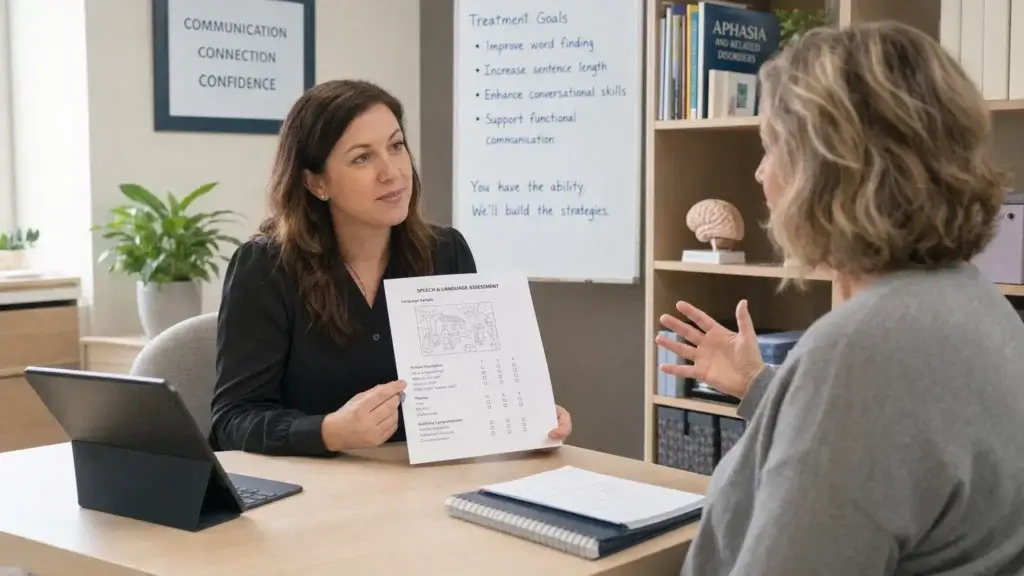
This is why a speech-language pathologist does more than listen to speech. The assessment may include oral motor tasks, voice checks, repetition, naming, conversation, comprehension questions, reading, writing and functional communication tasks.
A helpful way to remember Dysarthria vs Aphasia is to ask:
- Are the words correct but unclear? Dysarthria may be involved.
- Are the words hard to find or understand? Aphasia may be involved.
- Is speech inconsistent with visible effort to form sounds? Apraxia may also need to be considered.
How Speech Therapy Helps Dysarthria and Aphasia
Treatment should match the diagnosis. Personalized Speech therapy can support both conditions, but the exercises and strategies are different.
For dysarthria, therapy may focus on improving speech intelligibility. This can include breath support, voice strengthening, slower rate, over-articulation, pacing strategies and posture. Some people also need swallowing screening if coughing, choking or drooling is present.
For aphasia, therapy may focus on language recovery and communication participation. Activities may include word retrieval practice, sentence building, comprehension training, reading and writing tasks, conversation coaching and supported communication strategies for family members.
For people recovering from stroke, integrated rehabilitation is often needed. Bridges has a practical guide on speech therapy after stroke that explains how communication recovery can be built step by step.
In Dysarthria vs Aphasia treatment, the best plan is functional. The goal is not only to perform well in a therapy room. The goal is to talk with family, ask for help, return to work, participate socially and regain confidence.
Practical Communication Tips for Families
While waiting for assessment or between therapy sessions, families can make communication easier. These tips do not replace professional care, but they can reduce frustration.
First, reduce background noise. Turn off the TV during conversation and speak face to face. Give the person extra time to respond. Avoid finishing every sentence unless they ask for help.
For dysarthria, encourage shorter phrases, pauses and a slower rate. Ask the person to repeat one key word rather than the whole sentence. If their voice is soft, move closer instead of asking them to shout repeatedly.
For aphasia, use simple sentences, written keywords, gestures and pictures. Ask yes-or-no questions when needed, but also give opportunities for choice and conversation. For example, “Do you want tea or coffee?” may be easier than “What would you like?”
Most importantly, speak to the person as an adult or capable child, depending on their age. Communication difficulty is not the same as lack of understanding.
Latest Trends in Dysarthria and Aphasia Rehabilitation
Modern rehabilitation is becoming more personalized, practical and technology-supported. In Dubai and internationally, several trends are shaping therapy in 2026.
Hybrid therapy is increasingly common. Many patients benefit from a mix of clinic sessions, home programs and telehealth check-ins. This allows skills to be practiced in real-life environments while still receiving professional guidance.
Caregiver coaching is also becoming central. Research and clinical practice show that communication improves when family members learn how to cue, wait, simplify language and support conversation without taking over.
AAC, or augmentative and alternative communication, is another growing area. Low-tech tools such as picture boards and notebooks can help. High-tech speech-generating devices or apps may support people with severe communication needs.
Data-informed therapy is expanding too. Therapists may track speech clarity, word retrieval, communication participation and home practice consistency over time. Progress is not always linear, but measurable goals help families see meaningful change.
These trends support the main message of Dysarthria vs Aphasia care: therapy should be individualized, functional and connected to daily life.
When Should You Seek Help?
Seek professional assessment if speech or language changes last more than a few days, affect daily activities or appear after a neurological diagnosis. Sudden changes should be treated as urgent, especially if paired with weakness, facial drooping, confusion or severe dizziness.
You should consider speech-language evaluation if you notice persistent dysarthria and aphasia symptoms such as slurred speech, reduced voice volume, word-finding difficulty, trouble following conversation or new reading and writing problems.
A qualified speech-language pathologist can identify the difference between dysarthria and aphasia, screen for related swallowing or cognitive-communication concerns and build a realistic treatment plan. Families in Dubai can benefit from a multidisciplinary team that understands speech, movement, cognition, emotions and daily participation.
Conclusion: Getting the Right Support Matters
Dysarthria vs Aphasia is more than a medical comparison. It affects how a person connects with family, expresses needs and participates in daily life. Dysarthria is usually a motor speech problem, while aphasia is a language problem. The two can overlap, but the right assessment can clarify the diagnosis and guide effective therapy.
If you or a loved one is experiencing unclear speech, word-finding difficulty or communication changes after stroke, brain injury or a neurological condition, early support can help. Bridges Speech Center offers multidisciplinary care, family guidance and speech-language therapy tailored to each person’s needs.
To take the next step, contact us and book an assessment with the team at Bridges Speech Center in Dubai.
Frequently Asked Questions
What is the main difference between dysarthria and aphasia?
Dysarthria affects the muscle control needed for clear speech, while aphasia affects language understanding and expression. A person with dysarthria usually knows the words but cannot say them clearly. A person with aphasia may struggle to find, understand or organize words.
Can someone have dysarthria and aphasia at the same time?
Yes. This can happen after stroke, traumatic brain injury or neurological disease. When both are present, therapy should include goals for speech clarity and language skills.
What are the most common dysarthria and aphasia symptoms?
Dysarthria often causes slurred, quiet, slow or strained speech. Aphasia may cause word-finding difficulty, trouble understanding conversation, reading problems, writing problems or mixed-up sentences.
How does speech therapy help aphasia vs dysarthria speech disorder?
For dysarthria, therapy targets breathing, voice, articulation and speaking rate. For aphasia, therapy targets word retrieval, comprehension, sentence structure, reading, writing and everyday communication strategies.