
When a child repeats a word, question, cartoon line, song lyric or phrase they heard earlier, parents may feel confused. Is it a habit? Is the child ignoring the question? Is it a sign of delayed communication? In many autistic children, repeated speech can be an important window into how they process language.
Echolalia is the repetition of words or phrases spoken by someone else. It is common in many children during early language development. It can also be seen in autism, language delay, anxiety, developmental differences and neurological conditions. For families seeking Speech therapy Dubai, understanding repeated speech helps them respond with more patience and choose the right support.
The key message is simple: repeated speech is not meaningless. It may be a child’s way to communicate, regulate emotions, practice language or hold onto a familiar sound pattern while they learn how to use words more flexibly.
Table of Contents
ToggleEcholalia Meaning: More Than Copying
A practical echolalia meaning is “repeating spoken language that was heard before.” The repetition may happen right away or much later. A child might repeat “Do you want juice?” instead of saying “I want juice.” Another child might use a line from a favorite video to express excitement, protest or stress.
For many autistic children, echolalia can serve a real purpose. It may help them start interaction, answer in the only way they currently can or calm themselves in a busy environment. Instead of stopping the repetition immediately, parents and therapists first try to understand what the child might be communicating.
According to the American Speech-Language-Hearing Association, speech-language pathologists support autistic individuals with social communication, language, speech clarity and functional communication across daily settings. This is why assessment is so important before deciding on therapy goals.
Types of Echolalia Parents May Notice
Knowing the main types of echolalia can help you observe patterns instead of guessing. Repetition can look different from one child to another.
Type | What it looks like | Possible purpose | Example |
Immediate repetition | The child repeats words right after hearing them | Processing language, answering, keeping the interaction going | Parent says “Say bye” and child says “Say bye” |
Delayed repetition | The child repeats something heard minutes, days or weeks earlier | Expressing emotion, remembering routines, self-regulation | Child says a cartoon line when excited |
Communicative repetition | The repeated phrase is used to send a message | Requesting, protesting, greeting, commenting | “Time to go?” may mean “I want to leave” |
Non-communicative repetition | The phrase may not be directed to another person | Calming, practicing sounds, sensory enjoyment | Repeating a favorite rhythm while playing |
These categories are not rigid. A repeated phrase can be both comforting and communicative. The goal is to look at the situation, the child’s body language, the tone of voice and what happens before and after the phrase.
Echolalia Causes: Why Autistic Children Repeat Words and Phrases
Echolalia causes are often linked to how a child processes language, sensory input and social demands. Many autistic children learn language in chunks rather than one word at a time. This is sometimes called gestalt language processing. Instead of building speech from single words first, the child may store whole phrases like “Let’s go outside” or “Are you okay?” and use them later.
Repeated speech may also happen when a child needs more time to understand a question. Repeating the question can buy processing time. For example, if you ask “What did you eat at school?” the child might repeat the whole question while trying to organize an answer.
Other common reasons include anxiety, excitement, sensory overload, difficulty finding original words and strong memory for sounds. Some children repeat phrases because they enjoy the rhythm or emotional tone. Others use scripts because they are more reliable than spontaneous speech.
This does not mean the child is being rude or stubborn. Often, the child is using the tools available at that stage of communication development.
When Is Repeated Speech a Concern?
Repeated words are not automatically a problem. Many toddlers repeat words as they learn. However, professional support may be helpful if repetition is the child’s main way to communicate after age three, if the child struggles to answer simple questions or if repeated phrases replace meaningful interaction most of the time.
You may also want an assessment if your child has limited eye contact, few gestures, reduced pretend play, sensory sensitivities, frequent meltdowns or difficulty following daily routines. These signs do not confirm autism by themselves, but they show that a fuller developmental evaluation may be useful.
At Bridges Speech Center, therapists look beyond the repeated phrase. They observe how the child requests help, shares attention, understands language, plays, responds to people and manages sensory needs. This wider view helps families get a plan that fits the child rather than a one-size-fits-all approach.
Echolalia Autism Treatment: How Speech Therapy Helps
A good echolalia autism treatment plan does not simply aim to “make repetition disappear.” Instead, it helps the child turn repeated speech into flexible, meaningful communication. The therapist may interpret the child’s scripts, model shorter functional phrases and teach new ways to request, refuse, comment and ask for help.
For example, if a child repeats “Do you want bubbles?” While reaching for bubbles, the adult can model “I want bubbles” or “Bubbles please.” If a child repeats “All done?” During a noisy activity, the therapist may teach “I need a break.” Over time, the child learns phrases that match real needs.
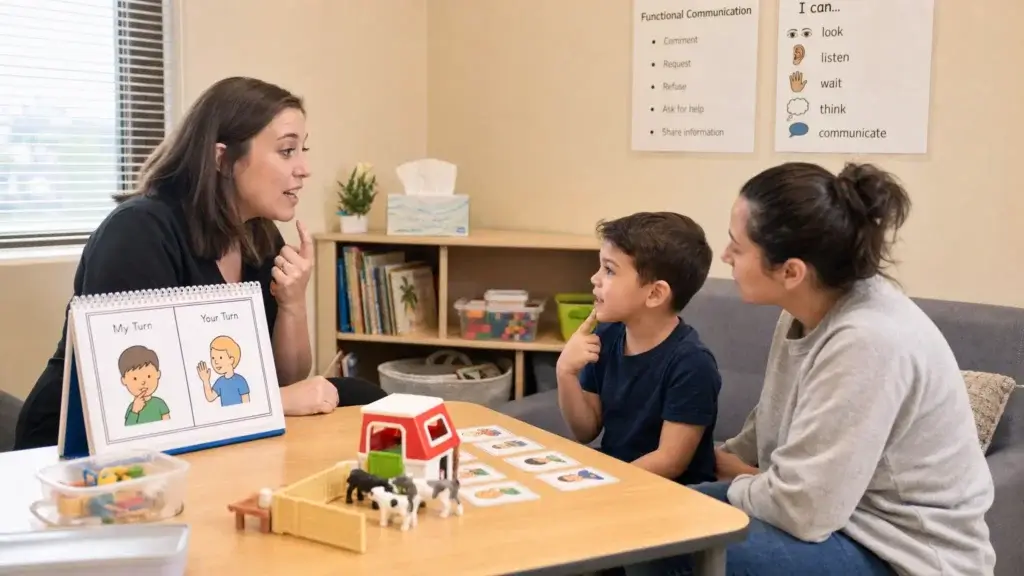
Professional speech therapy may include play-based language activities, visual supports, parent coaching, turn-taking games, social communication practice and alternative communication tools when needed. Some children benefit from AAC, such as picture boards or speech-generating devices. AAC does not stop speech development. It can reduce frustration and give the child a reliable way to communicate while spoken language grows.
For autistic children who also need support with sensory regulation, behavior or daily routines, Autism therapy can be combined with speech-language intervention. A coordinated plan may include occupational therapy, ABA-based support, psychology input and parent training.
Practical Tips Parents Can Use at Home
Parents play a powerful role because communication happens all day, not only in therapy sessions. The first step is to respond to the message behind the words.
Try these practical strategies:
- Listen for meaning: If your child repeats “Want cookie?” while looking at the kitchen, respond as if they are requesting. You can say, “You want cookies.”
- Model without pressure: Use short phrases your child can copy and adapt, such as “I want a car,” “Help me,” “More swing” or “Stop please.”
- Offer choices: Instead of asking open-ended questions all the time, say “Apple or banana?” while showing both items.
- Use visual support: Pictures, objects and gestures make language easier to understand.
- Pause and wait: Give your child extra time after you speak. Many children need several seconds to process.
- Avoid constant correction: Recasting the phrase is more helpful than saying “Don’t repeat me.”
Keep interactions natural. If your child loves dinosaurs, cars, music or water play, use those interests to create communication opportunities. Motivation makes learning easier.
Families in Dubai can also work with a speech therapy team to build a home program that matches the child’s age, language level and family routine.
Latest Trends in Supporting Repeated Speech
Current autism communication support is becoming more respectful, individualized and family-centered. Therapists are paying closer attention to gestalt language processing, which recognizes that some children learn language through meaningful chunks before they move toward flexible self-generated sentences.
Another important trend is neurodiversity-affirming care. This approach does not treat every repeated phrase as something “bad.” Instead, it asks whether the phrase is helping the child communicate, cope or connect. Therapy goals focus on increasing options, reducing frustration and supporting participation in real life.
Hybrid support is also growing. Many families combine clinic sessions, home practice, telehealth check-ins and school collaboration. Parent coaching is central because caregivers need clear strategies for daily routines like meals, bath time, bedtime, playdates and classroom transitions.
Data-informed therapy is another useful development. Therapists may track how often a child uses a phrase functionally, how many new flexible phrases appear and whether communication breakdowns decrease. Progress is not only about saying more words. It is also about being understood more often.
At Bridges Speech Center, individualized care may include speech-language therapy, parent involvement, home care options and multidisciplinary support when a child needs help across communication, sensory, feeding, emotional or motor areas.
What to Expect During an Assessment
A speech-language assessment usually starts with a detailed parent interview. The therapist asks about early milestones, first words, play, social interaction, sensory responses, school concerns and family goals. If the child repeats phrases, parents may be asked to share examples or short notes about when they happen.
The therapist then observes how the child communicates during play and structured tasks. They may check understanding, expression, speech sounds, oral motor skills, attention, pretend play and social communication. If autism is suspected or already diagnosed, the therapist may coordinate with other professionals for a broader picture.
Assessment should lead to clear goals. These may include using functional requests, answering simple questions, expanding scripts, using visual supports, increasing joint attention or building flexible phrases for daily routines. For many families, the most valuable part is learning what to do at home between sessions.
If your child needs broader developmental support, Autism therapy can help build communication, behavior, play and daily living skills in a structured way.
Conclusion
Repeated words and phrases can feel puzzling at first, but they often carry meaning. Some children use scripts to request, connect, process language or regulate emotions. The most helpful response is to look for the function, model practical language and seek professional guidance when communication feels stuck.
With the right support, children can move from repeated phrases toward more flexible and confident communication. Families do not have to figure it out alone. Bridges Speech Center provides individualized care for children and adults through speech-language therapy, autism support, occupational therapy, physiotherapy, psychology and parent training.
If your child repeats words or phrases and you are unsure what it means, speak with a qualified therapist. To book an assessment or ask about services in Dubai, please contact us.
Frequently Asked Questions
Is echolalia always a sign of autism?
No. Repeated speech can happen in typical development, language delay, anxiety and some neurological conditions. It is common in autism, but it should be considered alongside social communication, play, sensory patterns and developmental history.
Can echolalia be useful for communication?
Yes. A repeated phrase may be a request, protest, comment or way to manage emotions. Understanding the purpose helps adults respond more effectively and teach more flexible language.
Should parents stop a child from repeating phrases?
Not usually. Constantly stopping repetition can increase frustration. It is better to model a useful phrase, respond to the likely message and teach alternatives through calm practice.
When should I seek speech therapy for repeated speech?
Seek support if repeated phrases are the main way your child communicates, if understanding is limited, if frustration is high or if you notice other developmental concerns such as limited gestures, reduced social interaction or sensory challenges.