

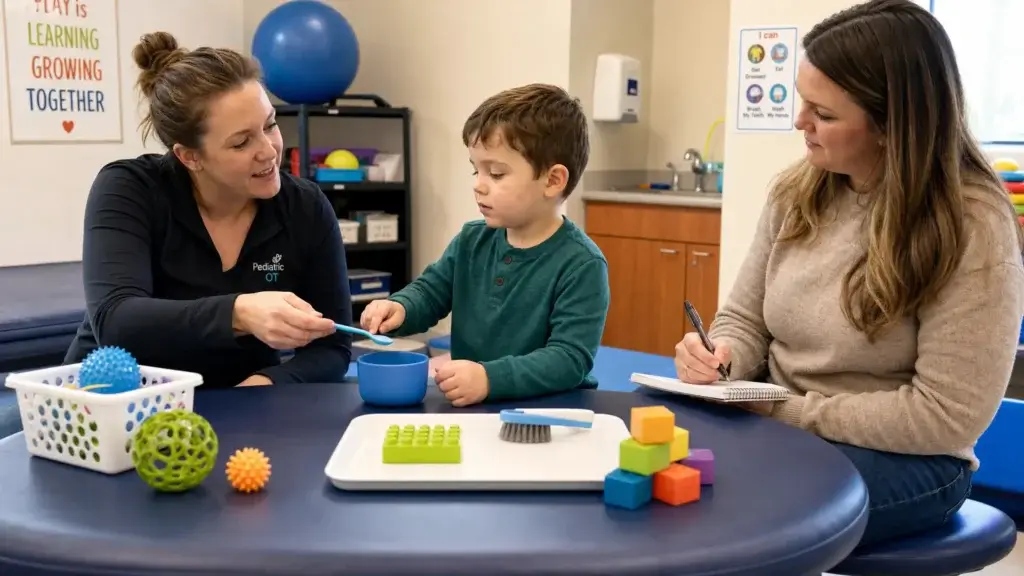
If your child avoids messy play, struggles with feeding, has frequent sensory meltdowns, or cannot manage age-expected self-care tasks, it can be hard to know whether to wait or ask for help. Early intervention OT helps families answer that question sooner, before small daily challenges become bigger barriers to confidence, learning, and independence.
Occupational therapy is not only about handwriting or exercises. For young children, occupation means the everyday activities that shape development: playing, eating, moving, dressing, sleeping, exploring, communicating, and joining family or nursery routines. When these activities are difficult, an occupational therapist can identify why and build practical strategies that fit the child and family.
Table of Contents
ToggleWhat Early Intervention OT Means
Early intervention OT is occupational therapy started during infancy, toddlerhood, or the preschool years when early signs of motor, sensory, feeding, play, or self-care difficulties appear. The goal is not to label a child. The goal is to support development while the brain and body are rapidly learning new skills.
An OT looks at how a child uses their hands, coordinates movement, responds to sensory input, manages transitions, participates in play, and completes daily tasks. Therapy is usually play-based, but it is structured around real functional goals such as holding a spoon, tolerating toothbrushing, climbing safely, dressing with less help, or sitting long enough for a short group activity.
Early intervention may be helpful for children with known diagnoses such as autism, ADHD, cerebral palsy, Down syndrome, developmental delay, prematurity, genetic conditions, or sensory processing differences. It can also help children who do not have a diagnosis but are showing repeated difficulties in daily routines.
Why Starting Early Matters
The early years are a powerful window for learning. The Harvard Center on the Developing Child explains that early experiences help shape brain architecture, especially when children have responsive support from adults. In practical terms, this means young children often learn best when therapy is embedded into everyday routines with caregiver coaching.
Early support can also reduce frustration. A child who cannot communicate sensory discomfort may cry, refuse, run away, or appear defiant. A child who struggles with fine motor control may avoid puzzles, crayons, feeding, or dressing. When families understand the skill behind the behavior, support becomes more effective and less stressful.
The American Academy of Pediatrics recommends developmental surveillance at every well-child visit and standardized developmental screening at 9, 18, and 30 months, with autism-specific screening at 18 and 24 months. These screenings do not replace a therapy assessment, but they reinforce an important message: developmental concerns are worth checking early.
The CDC developmental milestones are also useful for parents because they show common skills by age and encourage families to seek advice when milestones are missed or when skills do not seem to be progressing.
When Should Early Intervention OT Start?
Early intervention OT should start when a repeated pattern is affecting your child’s participation in daily life. One difficult day is not usually a concern. A consistent pattern across routines, such as every mealtime, every dressing routine, every playground visit, or every nursery day, deserves attention.
You do not need to wait for school failure, a formal diagnosis, or severe delay. If something feels harder than it should be and your child is becoming distressed, avoidant, or increasingly dependent, an OT screening can clarify whether therapy is needed.
Age or stage | Signs an OT assessment may help | Everyday examples |
0-12 months | Difficulty with tummy time, stiffness or floppiness, limited reaching, feeding coordination concerns, strong distress with touch or movement | Baby arches away during feeding, does not bring hands to mouth, dislikes being placed on the floor |
12-24 months | Delayed hand use, difficulty self-feeding, frequent falling beyond expected learning, limited exploration, unusual sensory reactions | Child avoids finger foods, uses one hand much more than the other, becomes very upset with textures |
2-3 years | Trouble using utensils, poor body awareness, limited pretend play, intense transitions, difficulty tolerating grooming | Child refuses toothbrushing, crashes into furniture often, cannot settle after minor changes |
3-5 years | Difficulty with dressing, scissors, crayons, playground play, attention, nursery routines, or sensory regulation | Child avoids coloring, cannot manage buttons or shoes, covers ears often, has frequent meltdowns in busy places |
Early school age | Handwriting fatigue, poor organization, clumsiness, difficulty sitting, self-care delays, low confidence in practical tasks | Child avoids written work, struggles with lunchbox packaging, needs more help than peers |
If a pediatrician suggests monitoring, ask what specific change you should expect and when to review again. Monitoring is most helpful when it has a clear timeline, not when it becomes indefinite waiting.
What Early Intervention OT Helps
Early intervention OT supports the foundation skills behind daily participation. The exact goals depend on the child, but most plans target a combination of motor, sensory, behavioral, and self-care needs.
Area OT supports | What it may look like | Possible therapy goals |
Fine motor skills | Weak grasp, poor finger control, avoiding puzzles, crayons, or small toys | Improve hand strength, pincer grasp, bilateral coordination, and early tool use |
Sensory processing | Overreacting to noise, touch, clothing, movement, or food textures | Build tolerance, regulation strategies, and safer ways to seek or avoid sensory input |
Motor planning | Clumsiness, difficulty learning new movements, trouble climbing or imitating actions | Improve sequencing, body awareness, coordination, and confidence in movement |
Feeding participation | Picky eating, gagging with textures, difficulty using utensils, oral sensory sensitivity | Support safe, positive mealtimes, oral motor skills, and gradual food exploration |
Self-care skills | Difficulty dressing, brushing teeth, washing hands, toileting routines, sleep routines | Increase independence through task breakdown, practice, and environmental changes |
Play and social participation | Limited play variety, difficulty taking turns, poor attention in shared activities | Expand purposeful play, joint attention, turn-taking, and flexible participation |
School readiness | Trouble sitting, cutting, drawing, following routines, managing transitions | Prepare for nursery or school tasks with practical, age-appropriate supports |
Fine motor and hand skills
Fine motor development supports much more than writing. Children use small hand movements for feeding, stacking blocks, opening containers, turning pages, dressing, and play. If a child avoids hand activities or becomes tired quickly, OT can build strength and coordination through playful, graded tasks.
Parents can also support this at home with simple activities such as playdough, stickers, tongs, clothespins, beads, and tearing paper. If you want practical ideas while waiting for an assessment, Bridges Speech Center has a helpful guide to fine motor skills activities at home.
Sensory processing and emotional regulation
Some children experience ordinary sensations as overwhelming. Others seek intense movement, pressure, or sound to feel organized. Sensory differences can affect sleep, feeding, behavior, attention, and social participation.
Early OT does not try to force a child to tolerate everything immediately. A therapist identifies sensory patterns, teaches regulation strategies, and helps families adjust routines so the child can participate more successfully. This may include movement breaks, deep pressure activities, visual routines, gradual texture exposure, or environmental changes.
For families managing sensory challenges at home, this guide to sensory integration therapy at home offers additional ideas.
Feeding, oral sensory skills, and mealtime confidence
Feeding is a complex skill involving posture, oral motor control, sensory tolerance, breathing, attention, and family routines. A child who refuses many foods may not simply be picky. They may be struggling with texture, smell, chewing, swallowing safety, or anxiety around new foods.
OT can be part of feeding support, often working alongside speech-language therapy when oral motor or swallowing concerns are present. Therapy may focus on seating, sensory exploration, utensil use, hand-to-mouth coordination, texture progression, and reducing pressure at meals. Bridges Speech Center also provides feeding therapy support for children who need a multidisciplinary approach.
Self-care and independence
Self-care skills develop gradually, but persistent difficulty may signal that a child needs extra support. Dressing, washing hands, brushing teeth, using a spoon, toileting routines, and cleaning up toys all require sequencing, body awareness, hand skills, sensory tolerance, and attention.
In early intervention OT, the therapist breaks tasks into achievable steps. For example, a child may first learn to pull off socks, then push arms through sleeves, then manage simple fasteners. Small gains matter because independence builds confidence.
Play, attention, and school readiness
Play is the main way young children practice problem-solving, communication, movement, and social flexibility. If a child repeats the same play pattern, avoids peers, struggles to imitate actions, or cannot shift between activities, OT can help build play skills and school readiness.
This is especially important when sensory or motor challenges affect learning. A child who cannot sit comfortably, hold tools, manage noise, or recover from transitions may appear inattentive when the real issue is regulation or motor demand.
What Happens During an Early Intervention OT Assessment?
A good OT assessment is not a quick checklist. It should connect your concerns to real daily routines and identify what helps your child succeed.
Assessment step | What the therapist looks at | Why it matters |
Parent interview | Pregnancy and birth history, development, feeding, sleep, play, behavior, family priorities | Parents know the child’s daily patterns best |
Observation | Movement, posture, hand use, attention, play, sensory responses, transitions | Shows how skills appear in real activity |
Functional task review | Dressing, feeding, grooming, school tasks, toy use, mobility in the environment | Links therapy goals to meaningful routines |
Developmental testing when needed | Fine motor, visual motor, sensory, coordination, or self-care measures | Helps document strengths, needs, and progress |
Goal planning | Family-centered, practical goals with home carryover | Makes therapy measurable and relevant |
After the assessment, the therapist should explain what is age-expected, what may need support, and what the first goals should be. If another discipline is needed, such as speech therapy, physiotherapy, psychology, ABA, or medical review, the OT should guide you clearly.
What Do Sessions Look Like?
Early intervention OT sessions are usually playful, but each activity has a purpose. A therapist may use swings, climbing tasks, puzzles, feeding practice, sensory bins, pretend play, dressing games, hand-strengthening activities, or calming routines. The key is that therapy is matched to the child’s needs, not a fixed set of exercises.
Parent involvement is essential. Children make the best progress when therapy strategies are practiced in normal routines, not only during clinic sessions. Your OT may coach you on how to position your child for feeding, how to reduce sensory overload before nursery, how to encourage independence in dressing, or how to create a short daily hand-skills routine.
Progress is usually gradual. Some families see early changes in confidence and tolerance before they see major skill changes. That is still progress because regulation often comes before participation.
Clinic, Home, or Telehealth: Which Format Is Best?
Families in Dubai often balance therapy with school, work, traffic, and family routines. The best therapy format depends on the child’s goals and the context where difficulties happen.
Therapy format | Best suited for | What to consider |
Clinic-based OT | Children needing specialized equipment, structured sensory-motor work, or focused assessment | Good for controlled practice and access to therapy tools |
Home-based OT | Children whose challenges happen mainly during feeding, dressing, sleep, play, or home routines | Helps therapists coach caregivers in the real environment |
Telehealth or online coaching | Follow-up, parent training, routine planning, and families who need flexible support | Works best when caregivers can actively participate |
Hybrid care | Children who benefit from both structured clinic work and real-life carryover | Often useful for sensory, feeding, and self-care goals |
Bridges Speech Center offers therapy options that may include clinic care, home care therapy services, and telehealth or online support depending on the child’s needs and family situation.
What Parents Can Do While Waiting for an OT Appointment
Home support should be simple and low-pressure. The goal is not to turn every moment into therapy. The goal is to create small daily opportunities for success.
- Offer 10 minutes of floor play each day with blocks, balls, pretend play, or simple movement games.
- Encourage hand use through snacks, stickers, playdough, water play, tongs, and safe household tasks.
- Let your child do one small part of a self-care routine, such as pulling socks off or placing a toothbrush in the cup.
- Use predictable routines before challenging tasks, especially meals, bath time, sleep, and nursery transitions.
- Notice sensory triggers such as noise, clothing tags, food smells, bright lights, or crowded places.
- Praise effort and participation rather than perfect performance.
- Reduce help gradually so your child has a chance to practice without feeling overwhelmed.
If an activity causes distress, stop and simplify it. Early intervention works best when children feel safe enough to try.
Common Myths About Early Intervention OT
Myth | More helpful truth |
My child is too young for OT | OT can support infants and toddlers when feeding, movement, sensory, or self-care concerns appear |
They will grow out of it | Some children do, but persistent patterns are worth assessing early |
OT is only for handwriting | Pediatric OT also supports sensory processing, feeding, play, motor planning, daily living skills, and regulation |
Sensory issues are just behavior | Behavior may be the child’s way of showing sensory overload, discomfort, or difficulty organizing their body |
Therapy means something is wrong with my child | Therapy is support for skill development, confidence, and family routines |
When to Seek Urgent Medical Advice
OT is important, but some signs need medical attention first. Contact your pediatrician or seek urgent care if your child has sudden loss of skills, seizures, repeated choking, poor weight gain, breathing difficulty during feeding, sudden weakness, severe pain, or a major change in alertness.
If feeding or swallowing safety is a concern, a medical and speech-language swallowing evaluation may be needed before starting food-based therapy activities.
How Bridges Speech Center Supports Early Intervention OT in Dubai
At Bridges Speech Center, early intervention is approached as a team effort. Families can access occupational therapy alongside speech therapy, feeding therapy, physiotherapy, psychology and psychotherapy, ABA and behavior therapy, and parent training when appropriate.
This multidisciplinary approach is helpful because children’s needs often overlap. A child with sensory food aversion may need OT and feeding therapy. A child with delayed play and communication may need occupational therapy and speech-language therapy. A child with motor delays may benefit from OT and physiotherapy working toward shared functional goals.
Bridges Speech Center provides individualized care for children and adults in a supportive environment, with options that may include home care therapy services and online support depending on clinical need. If you are unsure whether your child needs OT, a professional assessment can help you understand strengths, challenges, and practical next steps.
You can also read more about what an occupational therapist does or review signs in the guide Does my child need occupational therapy?.