

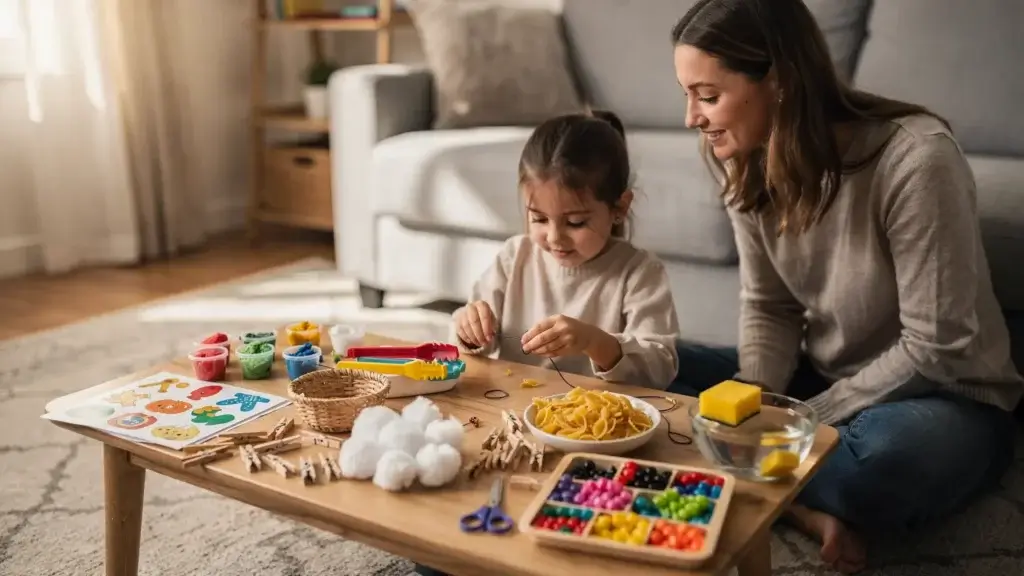
Preschoolers learn best through playful, hands-on experiences. The good news is that you do not need expensive toys or a long lesson plan to support fine motor development at home. Everyday actions like peeling stickers, squeezing a sponge, threading pasta, opening lunch boxes, and helping with dressing can strengthen the small muscles of the hands and fingers.
Fine motor activities are especially helpful between ages 3 and 5, when children are preparing for school tasks such as drawing, cutting, coloring, feeding themselves, buttoning, and early writing. The goal is not to make your child “perform” perfectly. The goal is to give them short, enjoyable chances to practice control, coordination, and confidence.
According to the CDC developmental milestones, preschool-age children gradually build skills such as using utensils, drawing simple shapes, unbuttoning, holding crayons with fingers, and writing some letters. These milestones vary from child to child, but playful practice can make daily tasks easier and more independent.
Table of Contents
ToggleWhat Fine Motor Skills Include in Preschoolers
Fine motor skills involve the small muscles of the hands, fingers, and wrists working together with the eyes, arms, and body. For preschoolers, these skills show up in many ordinary tasks: holding a crayon, turning book pages, using a spoon, zipping a bag, building blocks, and picking up tiny objects.
Occupational therapists often look beyond “hand strength” alone. A child may have enough strength but still struggle with coordination, finger control, attention, posture, or sensory tolerance. That is why the best activities fine motor development depends on are usually playful, varied, and connected to real life.
Skill area | What it looks like at home | Why it matters |
Hand strength | Squeezing, pinching, pulling, pushing | Helps with scissors, crayons, utensils, and dressing |
Pincer grasp | Picking up small items with thumb and index finger | Supports feeding, buttons, beads, and pencil control |
Bilateral coordination | Using both hands together | Helps with cutting, opening containers, lacing, and stabilizing paper |
Visual-motor coordination | Eyes guide hand movements | Supports puzzles, tracing, drawing, catching, and copying shapes |
Finger isolation | Moving one finger at a time | Helps with pointing, keyboard use, counting on fingers, and refined control |
Before You Start: Keep It Short, Safe, and Fun
Preschoolers do not need long practice sessions. Five to ten minutes of focused fine motor play is often enough, especially if it happens regularly. You can also build practice into daily routines, such as snack time, bath time, dressing, and clean-up.
Choose activities that feel slightly challenging but still possible. If your child becomes upset, avoids the task, or says “I can’t” repeatedly, make it easier. If they finish instantly without effort, add a small challenge. The best level is usually where your child succeeds most of the time but still needs to think and try.
Keep these safety tips in mind:
- Supervise small objects such as beads, buttons, coins, dried pasta, or pom-poms.
- Avoid tiny items if your child still mouths objects.
- Use child-safe scissors and age-appropriate tools.
- Let your child choose their preferred hand rather than forcing handedness.
- Stop if you notice pain, unusual fatigue, or strong frustration.
Easy Fine Motor Activities for Preschoolers at Home
The following activities use common household items and can be adapted for different skill levels. You can rotate them through the week rather than doing all of them at once.
Sticker Peel and Park
Stickers are a simple way to build pincer grasp, finger strength, and hand-eye coordination. Draw a road, rainbow, caterpillar, or simple shape on paper. Ask your child to peel stickers and “park” them along the line.
If peeling is too hard, lift one edge of the sticker before giving it to your child. If it is too easy, use smaller stickers or ask your child to match colors, follow a pattern, or place stickers inside small circles. This activity is also useful for children who avoid pencils, because it builds pre-writing control without pressure.
Playdough Shape Shop
Playdough is one of the most versatile fine motor tools for preschoolers. Ask your child to roll snakes, pinch small pieces, flatten pancakes, make pretend cookies, or hide small toys inside and rescue them.
To build more hand strength, invite your child to squeeze, twist, pull, and press the dough with both hands. For finger control, ask them to make tiny balls using the tips of the fingers. You can also pair playdough with speech and language practice by naming shapes, colors, actions, and pretend foods.
Clothespin Color Clip
Clothespins are excellent for strengthening the thumb, index finger, and middle finger. Place colored paper strips, cards, or a paper plate in front of your child. Ask them to clip clothespins around the edge or match colored clips to colored marks.
If regular clothespins are too stiff, start with easier clips or larger chip clips. If your child is ready for a challenge, ask them to pick up pom-poms with the clothespin and drop them into a cup. This supports the same hand muscles used for pencil grip and scissor control.
Tongs and Spoon Transfer Café
Create a pretend café using cotton balls, pom-poms, large pasta, cereal pieces, or toy food. Give your child tongs, a spoon, or a small scoop and ask them to transfer items from one bowl to another.
This activity builds grasp, wrist control, coordination, and attention. It can also support early math concepts if you count the items, sort colors, or make “orders” such as “three red berries and two yellow ones.” For children who find tongs difficult, start with a spoon. For children who need more challenge, use smaller items or ask them to transfer without spilling.
Sponge Squeeze Water Play
Water play can be calming and strengthening at the same time. Give your child a bowl of water and a sponge. Ask them to soak the sponge, squeeze it into another bowl, and watch the water move.
You can also use a spray bottle to water plants, a turkey baster to move water, or a dropper to make colored water dots on a paper towel. These actions strengthen the hands and improve graded pressure, which means using the right amount of force for a task. That same control helps with crayons, glue bottles, and utensils.
Paper Strip Snip and Collage
Cutting is a complex preschool skill because it requires both hands to work together. One hand holds and turns the paper while the other opens and closes the scissors. Start with narrow paper strips so your child can make one small snip at a time.
After cutting, turn the pieces into a collage. Your child can glue the pieces onto a paper plate, make a “rainbow soup,” or decorate a picture. This keeps the activity meaningful and avoids making scissor practice feel like a drill.
If your child struggles to hold scissors, check that the thumb is on top and the wrist is in a comfortable position. If cutting causes strong frustration, an occupational therapist can assess whether the difficulty is related to strength, coordination, hand dominance, posture, or motor planning.
Lacing, Threading, and Pasta Necklaces
Threading activities help with pincer grasp, bilateral coordination, and visual-motor planning. Use large beads, cut straws, cardboard shapes with holes, or tube pasta. A pipe cleaner is easier than string because it stays firm while your child threads items onto it.
For a simple version, ask your child to place large pasta onto a pipe cleaner. For a harder version, make a pattern such as red-blue-red-blue or ask your child to lace around the edge of a cardboard shape. Always supervise closely if you use small pieces.
Button, Snap, and Zipper Practice
Self-care tasks are some of the most practical fine motor activities for preschoolers. Use old shirts, dress-up clothes, doll clothes, bags, or jackets to practice buttons, snaps, zippers, and Velcro.
Start with large buttons on loose fabric because they are easier to manage than small buttons on clothing the child is wearing. Once your child understands the movement, practice during dressing routines. Keep it playful by saying, “Let’s help teddy get ready,” or “Can you zip the delivery bag?”
This type of practice supports independence and confidence, especially for children preparing for nursery, preschool, or kindergarten.
Pre-Writing Sensory Tray
Before children write letters, they need to understand lines, shapes, direction, and pressure. Fill a shallow tray with sand, salt, rice, or a thin layer of flour. Ask your child to draw lines, circles, crosses, waves, and simple shapes with one finger.
If your child dislikes messy textures, use a dry paintbrush, cotton bud, or sealed sensory bag instead. You can also practice on a vertical surface such as a whiteboard or paper taped to the wall. Vertical work encourages wrist extension and shoulder stability, both of which help with pencil control.
Snack Prep for Small Hands
Snack time can become a natural fine motor session. Your child can peel a banana, open a lunch box, spread soft cheese with a child-safe knife, place toppings on crackers, or use tongs to serve fruit.
These tasks are motivating because they have a real purpose. They also connect fine motor skills with feeding independence, sequencing, and sensory tolerance. If your child has feeding difficulties, frequent gagging, or strong food avoidance, consider professional guidance before introducing challenging food textures.
Quick Activity Guide for Busy Parents
If you are short on time, choose one activity based on the skill your child needs most. This table can help you match the activity to a practical goal.
Home activity | Main fine motor target | Make it easier | Make it harder |
Sticker path | Pincer grasp and visual control | Lift sticker edge first | Use tiny stickers or patterns |
Playdough bakery | Hand strength and finger control | Use softer dough | Hide small objects to find |
Clothespin clipping | Pinch strength | Use larger clips | Clip pom-poms into cups |
Tongs transfer | Grasp and coordination | Use a spoon | Use smaller items or sorting rules |
Sponge squeeze | Hand strength and pressure control | Use a soft sponge | Use spray bottles or droppers |
Paper snipping | Scissor skills | Use narrow strips | Cut along thick lines |
Threading pasta | Bilateral coordination | Use pipe cleaners | Use string and patterns |
Button practice | Dressing independence | Use large buttons | Practice on worn clothing |
Sensory tray drawing | Pre-writing strokes | Use finger or brush | Copy shapes or letters |
Snack prep | Functional independence | Use easy-open containers | Add multi-step snack tasks |
How to Build Fine Motor Practice Into Daily Routines
The easiest home program is the one your family can actually repeat. Instead of setting aside a formal “therapy time,” look for small opportunities during routines you already do.
At breakfast, your child can open a container, stir yogurt, peel fruit, or use tongs. During dressing, they can pull socks up, close Velcro shoes, or try one button. During bath time, they can squeeze sponges, pour water, and spray bath toys. During story time, they can turn pages, point to pictures, and use finger puppets.
The American Academy of Pediatrics highlights that play supports children’s cognitive, physical, social, and emotional development. In other words, playful fine motor practice is not “just play.” It is how many preschoolers build the foundation for school and daily life.
A Simple Weekly Fine Motor Plan
You do not need to practice every skill every day. A balanced week gives your child variety while keeping things manageable.
Day | 5 to 10-minute activity | Everyday carryover |
Monday | Playdough bakery | Help open snack containers |
Tuesday | Sticker path | Turn book pages at bedtime |
Wednesday | Tongs transfer café | Use spoon or fork at meals |
Thursday | Paper snip collage | Help tear lettuce or paper for crafts |
Friday | Sponge squeeze water play | Squeeze washcloth during bath |
Saturday | Threading pasta | Help zip a bag before going out |
Sunday | Button or dress-up practice | Choose one dressing task to do independently |
If your child has a short attention span, divide practice into two or three tiny moments across the day. A preschooler may do better with three minutes before lunch than with a longer session after they are tired.
What If Your Child Avoids Fine Motor Activities?
Avoidance can happen for many reasons. Some children have weak hands, some have difficulty planning movements, and some are sensitive to textures such as glue, dough, or wet materials. Others avoid tasks because they have experienced too much correction and now expect failure.
Start with activities your child already enjoys. If they love cars, add stickers to a road map. If they like to pretend to play, make a playdough pizza shop. If they enjoy water, use sponge squeezing. Motivation matters, especially for preschoolers.
Try to praise effort rather than perfect results. Say, “You kept trying to open the clip,” or “I noticed you used both hands,” instead of only praising the finished product. This helps your child develop confidence and persistence.
If your child becomes overwhelmed by textures, do not force messy play. Offer tools, gloves, dry materials, or alternative textures. Sensory comfort is an important part of participation, and some children benefit from sensory integration support alongside fine motor work.
When to Consider an Occupational Therapy Evaluation
Every child develops at their own pace, and occasional clumsiness is normal. However, persistent fine motor difficulties can affect preschool participation, self-care, confidence, and early learning. An occupational therapy assessment can identify why a task is hard and what type of support will help.
Consider seeking professional advice if your preschooler:
- Avoids coloring, puzzles, blocks, or table activities most of the time.
- Has great difficulty using a spoon, fork, cup, or lunch box compared with peers.
- Cannot manage simple dressing tasks such as pulling up pants, removing socks, or trying large buttons.
- Uses a very tight, awkward, or painful-looking crayon grasp.
- Struggles to copy simple lines, circles, or crosses after repeated practice.
- Becomes very frustrated with scissors, beads, stickers, or small toys.
- Uses one hand much less than the other, or shows sudden loss of skills.
- Has fine motor concerns along with sensory, attention, speech, feeding, or developmental challenges.
At Bridges Speech Center in Dubai, pediatric occupational therapy can support fine motor skills, self-care, sensory processing, play, school readiness, and independence. For some children, fine motor concerns are connected with broader developmental needs, so a multidisciplinary approach may include speech therapy, feeding therapy, physiotherapy, psychology, or ABA support when appropriate.
You can also explore our related guide on fine motor activities for kids for a short daily routine, or read more about hand-eye coordination in child development.
Need Help Supporting Your Child’s Fine Motor Skills?
If your preschooler struggles with hand skills, dressing, feeding independence, sensory play, or early school tasks, Bridges Speech Center can help. Our team in Dubai provides individualized occupational therapy, parent guidance, home care therapy services, and multidisciplinary support for children with a wide range of developmental needs. If you want to discuss your child’s concerns, book an assessment with Bridges Speech Center today.
Frequently Asked Questions
How often should preschoolers do fine motor activities at home?
Short, regular practice works best. Aim for 5 to 10 minutes most days, or build small fine motor moments into meals, dressing, bath time, and play.
What are the best fine motor activities for a 3-year-old?
Good options include playdough, large stickers, sponge squeezing, turning pages, simple puzzles, large bead threading, and transferring objects with a spoon. Keep tasks large, safe, and playful.
Should I correct my child’s pencil grip every time?
Gentle guidance is helpful, but constant correction can make children avoid drawing. Build hand strength and finger control through play first. If the grip looks painful, very immature, or affects participation, an occupational therapist can help.
What if my child refuses scissors or coloring?
Start with non-pencil activities such as stickers, playdough, tongs, water play, and vertical drawing. Refusal may be linked to frustration, weak hands, sensory discomfort, or coordination difficulty.