
If you have been told to see a language pathologist, you might wonder what that title actually means. In Dubai and across the UAE, the terms language pathologist, speech therapist, speech-language pathologist, and speech and language therapist are often used interchangeably. They all refer to the same licensed professional who evaluates and treats communication, language, speech, voice, fluency, social communication, cognitive-communication, and swallowing challenges across the lifespan.
What a language pathologist actually does
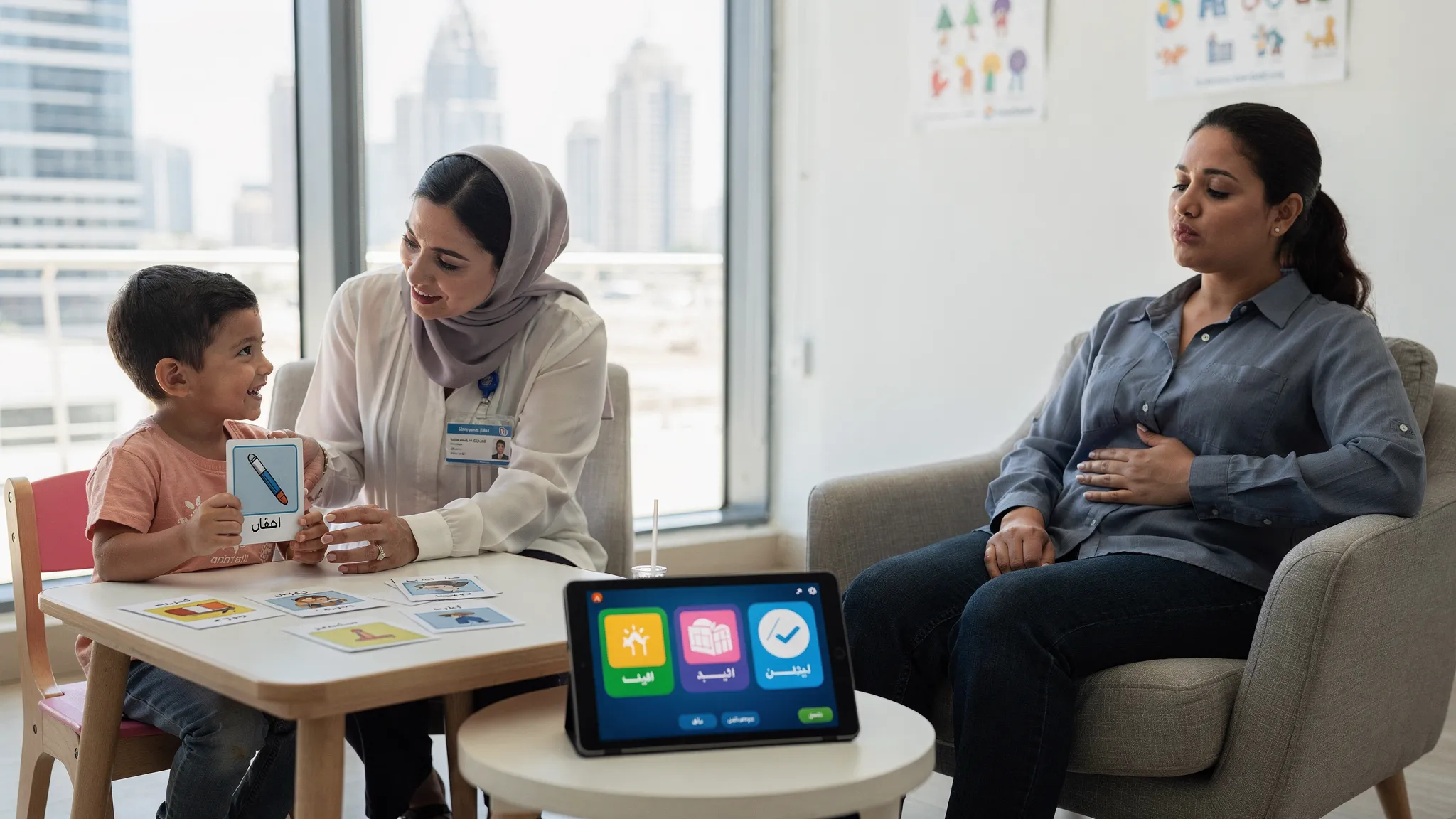
A language pathologist helps people understand and use language, speak more clearly, communicate confidently, and swallow safely. According to the American Speech-Language-Hearing Association, the scope includes assessment and treatment of speech sound production, language, social communication, cognitive-communication, voice, fluency, and swallowing across the lifespan ASHA Scope of Practice. The UK’s Royal College of Speech and Language Therapists describes a similar remit across health, education, and community settings RCSLT overview.
Here are the core areas you might encounter:
- Speech sound production and articulation: clarity of sounds and words, including phonological processes and motor planning difficulties.
- Language and literacy: understanding and using words and sentences, grammar, vocabulary, narrative skills, and reading and writing foundations.
- Fluency: reducing stuttering or stammering and building easier, more confident speech.
- Voice and resonance: healthy voice use, pitch, loudness, vocal fatigue, and nodules.
- Social communication: conversation, nonverbal cues, perspective-taking, and pragmatic language, often crucial in autism support.
- Cognitive-communication: attention, memory, problem solving, and executive skills, especially after concussion, TBI, stroke, or with neurodegenerative conditions.
- Swallowing and feeding: safety, oral motor skills, sensory food aversions, mealtime confidence for children and adults.
- AAC (augmentative and alternative communication): communication tools from picture boards to speech-generating devices and eye gaze systems.
| Core area | What that means | Examples of therapy goals |
|---|---|---|
| Speech clarity | Producing sounds accurately and smoothly | Improve /r/ or /s/ production, increase overall intelligibility |
| Language | Understanding and expressing ideas | Expand vocabulary, build sentence length, follow multi-step directions |
| Fluency | Smooth, easy speech | Reduce physical tension, increase confidence in class or meetings |
| Voice | Healthy, efficient voice | Improve breath support and resonance, reduce hoarseness |
| Social communication | Using language with others | Initiate and maintain conversations, read social cues |
| Cognitive-communication | Thinking and communicating | Strengthen memory strategies, organize information, plan tasks |
| Feeding and swallowing | Safe, efficient eating and drinking | Advance texture tolerance, reduce coughing, protect lungs |
| AAC | Alternate ways to communicate | Customize vocabulary, train partners, integrate device at home and school |
Who benefits from seeing a language pathologist
Children may be referred for late talking, speech sound errors, language delays, stuttering, social communication needs in autism, reading and spelling struggles, or picky eating and gagging. Adults are often seen after stroke, traumatic brain injury, Parkinson’s disease, multiple sclerosis, dementia, head and neck surgery, or for voice and professional communication needs.
Explore related topics on our site:
- Adult recovery support and real-world outcomes in adult speech therapy
- How AAC empowers communication in our AAC guide
- Practical swallowing safety in dysphagia and heartburn
- Why timing matters in early intervention
What training and credentials do language pathologists have
Training is rigorous and blends university coursework with extensive supervised clinical practice. Requirements vary by country, but most paths include the elements below. In the UAE, clinicians practice under a license from the relevant health authority such as the Dubai Health Authority, Department of Health Abu Dhabi, or MOHAP. Many clinicians also hold credentials from their country of training.
| Training component | What to expect |
|---|---|
| University degree | A professional degree in speech and language pathology, often at master’s level depending on the country |
| Supervised practicum | Hundreds of hours of patient-facing practice across ages and disorders under licensed supervisors |
| Mentored practice | A period of mentored clinical work after graduation where applicable, focused on independent case management |
| Licensure/registration | Meeting requirements of local health authorities, with primary-source verification of education and experience |
| Continuing professional development | Ongoing education each year to stay current with evidence and techniques |
Credible international references on roles and preparation include the ASHA Scope of Practice and the RCSLT overview. When choosing a provider in Dubai, it is reasonable to ask about licensure, years of experience, and specific training related to your goals such as fluency, AAC, feeding, or neurological rehabilitation.
Where language pathologists work and what therapy looks like
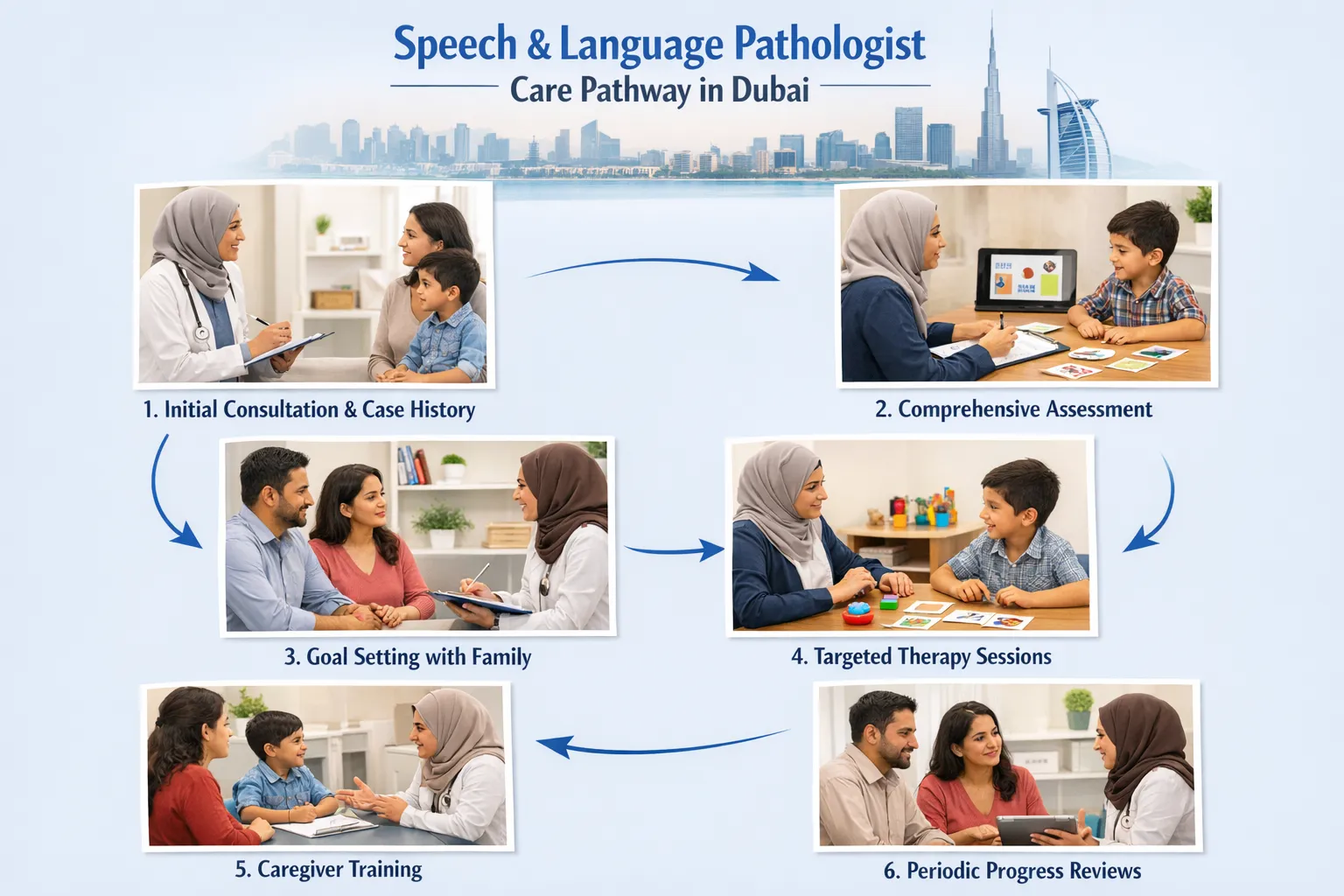
Language pathologists practice in hospitals, private clinics, schools, rehabilitation centers, homes, and through secure telehealth. A typical care pathway includes:
- Comprehensive evaluation: detailed history, standardized tests, observation, and functional measures. For swallowing, instrumental studies may be recommended by medical partners.
- Clear goals and plan of care: functional, measurable goals for home, school, or work settings with the right dose and frequency of therapy.
- Evidence-based intervention: approaches matched to the diagnosis, age, language background, and personal priorities.
- Home program and coaching: practical activities between sessions to speed progress.
- Progress reviews: data-informed updates to keep therapy focused and efficient.
Bridges Speech Center offers in-clinic sessions, home therapy, and telehealth, with strong parent and caregiver training to carry skills into daily routines.
A multidisciplinary approach makes outcomes stronger
Communication rarely exists in isolation. Language pathologists often collaborate with occupational therapy for sensory and fine motor needs, physiotherapy for posture, breath support and mobility, psychology for anxiety or attention, and ABA when behavior programming is appropriate. This integrated approach can be especially important for autism, ADHD, developmental coordination challenges, brain injury, and progressive neurological conditions.
Learn more about complementary services on our site, including Feeding Therapy and practical clinic selection tips in our Guide to choosing a speech therapy clinic in Dubai.
Signs you should consider seeing a language pathologist
- Your toddler is not babbling by around 12 months, has very few words by 18 months, or struggles to combine words by 2 to 3 years.
- Teachers report difficulty following instructions, telling stories, or understanding classroom language.
- Your child avoids certain textures, coughs when drinking, or mealtimes are consistently stressful and prolonged.
- You or a family member notice stuttering that causes frustration or avoidance.
- After stroke or brain injury, there is difficulty finding words, understanding others, organizing thoughts, or remembering steps.
- Your voice is chronically hoarse, fatigued, or unreliable for work demands.
- Coughing during meals, frequent chest infections, or unintentional weight loss raise concerns about swallowing safety.
Early screening helps. It is common for families to seek an initial consultation to understand whether therapy is needed now or if watchful waiting with home strategies is appropriate.
What to ask when choosing a language pathologist in Dubai
- Are you licensed with the relevant UAE health authority, and do you have experience with my specific concern?
- What will the evaluation include and how will goals be set and measured?
- What methods do you use, and how will you involve me at home, school, or work?
- How often should we attend and how long might therapy take to reach our goals?
- Do you coordinate with my physician, teacher, or employer when appropriate?
For a deeper checklist, see our practical clinic selection guide.
How Bridges Speech Center supports your goals
At Bridges Speech Center in Dubai, licensed language pathologists provide individualized therapy for children and adults. Care plans are tailored to your priorities and may include articulation and phonology support, language intervention and literacy foundations, fluency therapy, voice rehabilitation, cognitive-communication strategies, swallowing and feeding therapy, AAC assessment and training, and accent and professional communication coaching.
Therapy can be delivered in clinic, at home, or online. Our multidisciplinary team integrates speech therapy with occupational therapy, physiotherapy, sensory integration, clinical psychology and psychotherapy, CBT, and ABA when indicated. Parent and caregiver coaching is built into every program so progress continues between sessions.
Ready to talk through your concerns or book an assessment in Dubai, UAE? Call +971-505226054 or 043581115, or visit Bridges Speech Center to get started. If you prefer sessions at home, explore our speech therapist home service.