
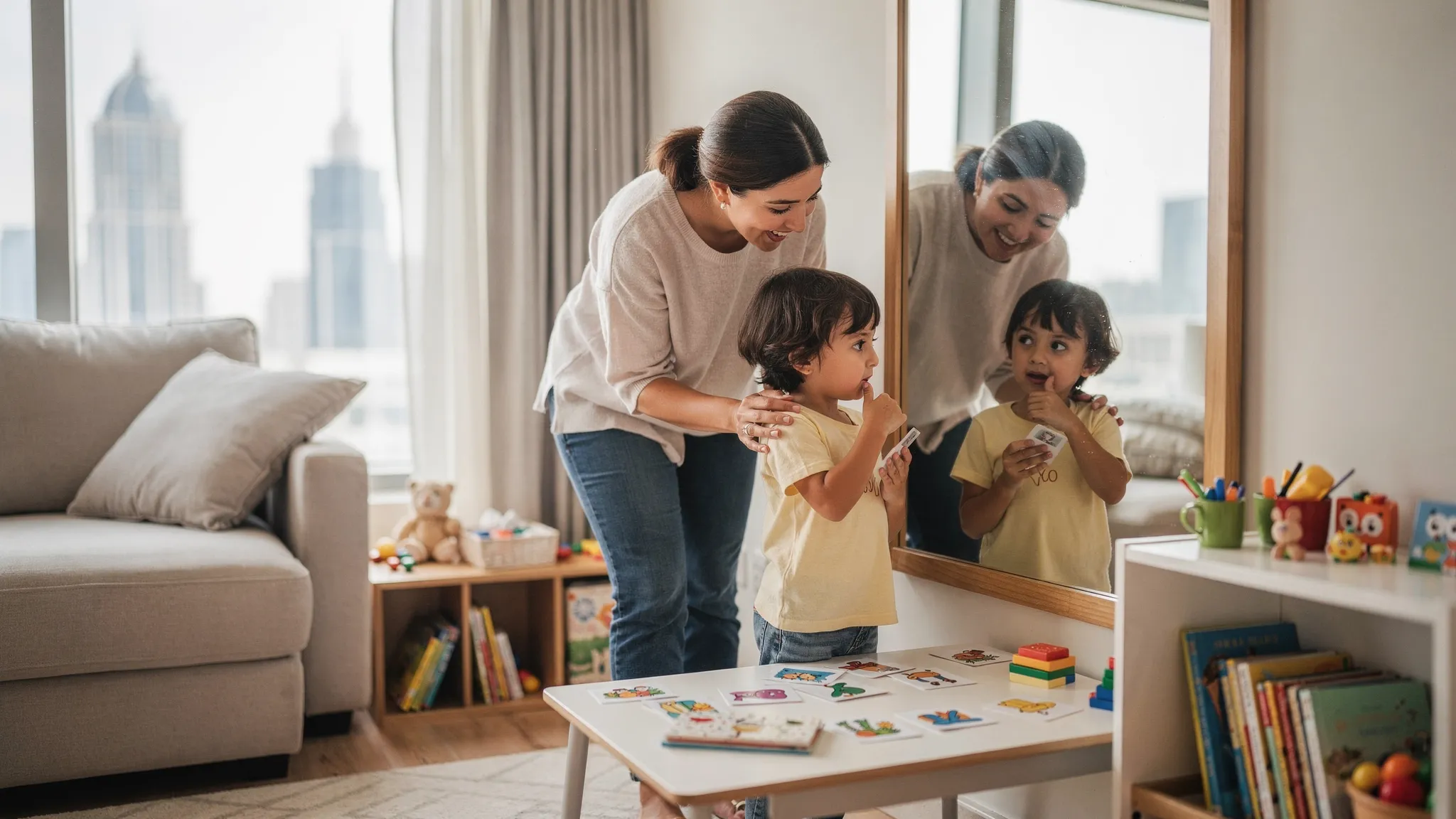
Parents often ask how to help a child be understood more easily at home, in class, and on the playground. Clear speech grows from daily, play‑based habits that build accurate sound placement, steady breath, and confident practice in real conversations. Below are practical talk speech tips, grounded in speech‑language therapy, that you can start today. If you suspect more than a mild lag, early assessment makes a big difference.
What “clear speech” means in everyday life
Clear speech, also called intelligibility, is how easy it is for an unfamiliar listener to understand your child. Clinicians often use a simple rule of thumb for typical development: around age 2, a child is understood about half the time by unfamiliar listeners, about three quarters by age 3, and most of the time by age 4. Individual rates vary, especially in multilingual environments like Dubai, but steady month‑to‑month improvement is expected.
Two quick pointers before you start home practice:
- Rule out hearing issues. Even a mild, temporary hearing loss from congestion or ear infections can blur speech sounds. Your pediatrician or audiologist can check.
- Keep practice short and frequent. Five to ten minutes daily beats one long weekend session.
For background on speech sound development and evidence‑based treatment, see the American Speech‑Language‑Hearing Association’s overview of speech sound disorders ASHA Practice Portal. Balanced media habits also support language growth, guidance is available from the American Academy of Pediatrics’ family media resources on HealthyChildren.org.
Is it articulation, phonology, or motor speech?
Understanding the pattern helps you choose the right practice.
- Articulation, difficulty making a specific sound accurately, for example a lisp on “s.”
- Phonology, predictable sound patterns, for example always saying “tar” for “car” or dropping last sounds.
- Motor speech, planning and coordination challenges, speech may be inconsistent or effortful, for example childhood apraxia of speech.
If errors are many, hard to predict, or your child becomes very frustrated, a professional assessment is wise.
Five Talk Speech Tips you can start today
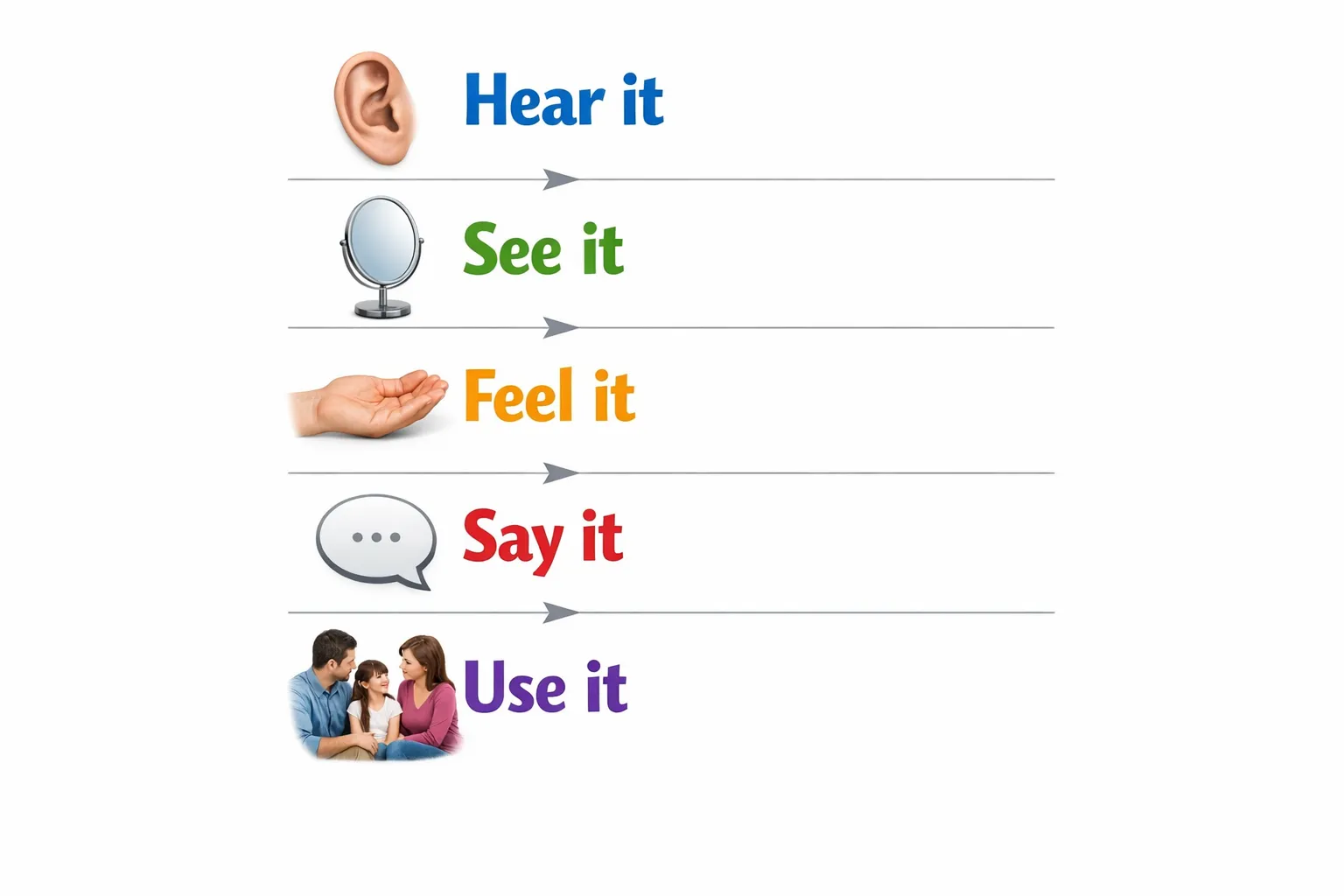
Use this simple five‑step cycle each practice time. Think, Hear it, See it, Feel it, Say it, Use it.
- Hear it, choose one target sound or word pattern. Play a few clear recordings or say several correct examples so your child hears the difference. Example, “sun, soup, soap” for the “s” sound.
- See it, show how your mouth looks. Use a mirror. For “s,” teeth together, lips in a smile, tongue behind the teeth. For “k,” tongue tip stays down while the back of the tongue lifts.
- Feel it, add a simple placement cue. Try a clean finger just below the nose to feel steady air for “s,” or a gentle knuckle press under the chin to help the back of the tongue lift for “k.”
- Say it, move from sound to syllable to word to short phrase. Keep it fun, use picture cards, toys, or actions. Provide feedback like “Nice long snake sound in ‘sun’.”
- Use it, finish with a quick game or mini‑chat that uses the target naturally. Example, a pretend shop, “I see six soaps.”
Common patterns and quick home ideas
Here are everyday ways to target frequent error patterns. Use real words and keep it playful.
| Pattern | Typical example your child might say | Try these minimal pairs | Home tip |
|---|---|---|---|
| Fronting, saying t for k or d for g | “tar” for “car,” “do” for “go” | key vs tea, car vs tar, go vs dough | Use a spoon handle to gently touch the back ridge of the tongue side as a cue, say “back sound,” then fade the cue quickly. |
| Stopping, saying t or d for s, z, f | “tun” for “sun,” “dip” for “zip” | sun vs tun, zip vs dip, fan vs tan | Whisper the target first to feel airflow, then add voice, “ssssun,” then “sun.” |
| Final consonant deletion | “bee” for “beep,” “no” for “nose” | beep vs bee, seat vs see, nose vs no | Clap on the last sound, “bee‑p,” then say it together. Try tapping a block for the final sound. |
| Cluster reduction | “pane” for “plane,” “tar” for “star” | plane vs pane, star vs tar, spoon vs soon | Start with an easy cluster like “sp,” add a tiny pause, “s‑poon,” then smooth it. |
| Gliding, w for r or l | “wabbit” for “rabbit” | light vs wight, red vs wed | Smile and lift tongue tip for “l,” try “la, lee, lie,” then put into words. Avoid overcorrecting every “r” early on, build success with “l” or simple “r” in “ra, ree.” |
Aim for success, pick one pattern at a time and celebrate small wins.
By age group, what should practice look like?
Toddlers, 1 to 2 years
- Focus on simple syllables, animal sounds, and play sounds, for example “moo,” “baa,” “pop.”
- Use sound‑loaded play, push a car and say “go, go,” pop bubbles “pop, pop,” stack blocks “up, up.”
- Expand gently, if your child says “ba,” you say “ball,” then “big ball.”
Preschoolers, 3 to 5 years
- Build accurate placement for tricky sounds, “k, g, s, z, l, r, sh, ch.”
- Practice through games, memory match with picture pairs, fishing game with target words, or treasure hunts that include target sounds in clues.
- Use short phrases before sentences, “two socks,” “green car,” then “I see a green car.”
Early school age, 5 to 7 years
- Add reading and writing to reinforce sound patterns, highlight target sounds in a short book.
- Rotate words, phrases, then short conversations, for example a 2 minute show and tell.
- Record and replay short clips to self‑evaluate, “Which one sounded clearer, number 1 or number 2.”
For a broader view of expected language growth in the early years, see our guide to language milestones.
A 7‑day, 10‑minute practice plan
Keep sessions short, positive, and routine.
- Day 1, Listening warm‑up, 10 correct models of your target sound in words. Child points to pictures as they hear the sound.
- Day 2, Mirror practice, 2 minutes on sound and syllables, then 8 minutes on words.
- Day 3, Minimal pairs, play a quick “pick the picture” game, 10 trials.
- Day 4, Phrase builder, add one describing word to each target, “big sun,” “green soap.”
- Day 5, Movement game, say the target while hopping or rolling a ball, 20 trials across the game.
- Day 6, Real talk, 2 minute chat using target words, for example items in the fridge, then listen to a short recording together.
- Day 7, Review and reward, mix easy and slightly harder words, place a sticker on the calendar for effort, not perfection.
Do’s and don’ts for clearer speech at home
-
Do slow your own speech slightly, add natural pauses. Your child will mirror your rhythm.
-
Do reduce background noise, turn off TV and music during practice.
-
Do model, not correct, say the word back correctly with emphasis, “Yes, car, I see the car.”
-
Do keep practice fun, use games, movement, and choices, “Which one do you want to try first.”
-
Do link mouth awareness to speech if you use oral‑motor tools. Blowing bubbles alone will not fix a lisp, pair any tool with real speech targets. See our guide to oral motor exercises for safe, therapist‑guided ideas.
-
Do not ask for constant repeats in regular conversation. Save structured attempts for practice time.
-
Do not compare siblings or classmates. Progress is individual, especially in multilingual homes.
-
Do not overload targets. One focus at a time builds momentum.
Special notes for multilingual families in Dubai
Bilingualism does not cause speech disorders. Many multilingual children take a little longer to stabilize certain sounds, especially ones that do not exist in all of their languages. Tips:
- Speak the language you are most fluent in when you model. Accuracy beats mixing many languages in a single practice.
- Keep exposure rich and interactive in each language, books, songs, and daily routines.
- Expect some sound substitutions that reflect the other language’s sound system, this is normal transfer, a speech‑language evaluation can differentiate transfer from a disorder. Explore our article on multilingualism and speech therapy.
When to seek a professional evaluation
Consider booking an assessment if you notice any of the following red flags:
- Your child is hard for unfamiliar listeners to understand most of the time after age 3.
- They regularly leave off first or last sounds in words after age 3.
- Many sounds are produced with the tongue between the teeth, or there is persistent drooling or low muscle tone that affects clarity.
- Speech is very inconsistent or extremely effortful, or there is a history of frequent ear infections.
- There is frustration, avoidance of speaking, or your child asks you to “say it for me.”
If you are concerned about a broader language delay in toddlers, these tips may help while you arrange a screening, see our guide to speech delay in toddlers.
How Bridges Speech Center supports clear speech
At Bridges Speech Center in Dubai, our speech‑language pathologists use evidence‑based approaches tailored to your child’s profile. Therapy may include:
- Sound placement and phonological contrast therapy, to build accurate productions and eliminate error patterns.
- Play‑based and functional communication tasks, to carry gains into everyday life at home and school.
- Motor‑based techniques when appropriate, for example PROMPT therapy, to guide jaw, lip, and tongue movements for children with motor planning needs.
- Parent coaching, you leave each session with a simple home plan and a handful of activities to reinforce progress.
- Integrated support, occupational therapy for sensory and attention needs, feeding therapy for oral‑motor coordination, and psychological support when anxiety affects communication.
- Flexible access, in‑clinic sessions, home speech therapy in Dubai, and telehealth options.
We track progress with simple, child‑friendly measures, for example percentage of correct targets in words and phrases, listener ratings of intelligibility, and real‑life goals like being understood when ordering in a cafe.
A final word of encouragement
Consistency, not perfection, is your best tool. Choose one target, practice for 10 minutes most days, and celebrate effort. If you would like a personalized plan, screening, or therapy that comes to you, our team is ready to help.
- Call or WhatsApp, +971‑505226054
- Clinic, 043581115
- Learn more, visit Bridges Speech Center, Dubai, and book your child’s assessment at bridgesspeechcenter.ae
Early support builds confidence, friendships, and a strong foundation for learning. Let’s help your child speak clearly and be heard.