

Fine motor development is the foundation of everyday independence, from holding a spoon and turning pages to buttoning a shirt and writing. Understanding what is typical at each age, and which signs suggest a need for support, helps families act early and confidently.
What is fine motor development?
Fine motor skills involve small, precise movements of the hands, fingers, and wrists combined with visual attention and coordination. These skills build gradually, starting with early reaching and grasping, then moving toward tool use, dressing, self-feeding, and handwriting. Strong posture and shoulder stability, good sensory processing, and plenty of play opportunities all support fine motor growth.
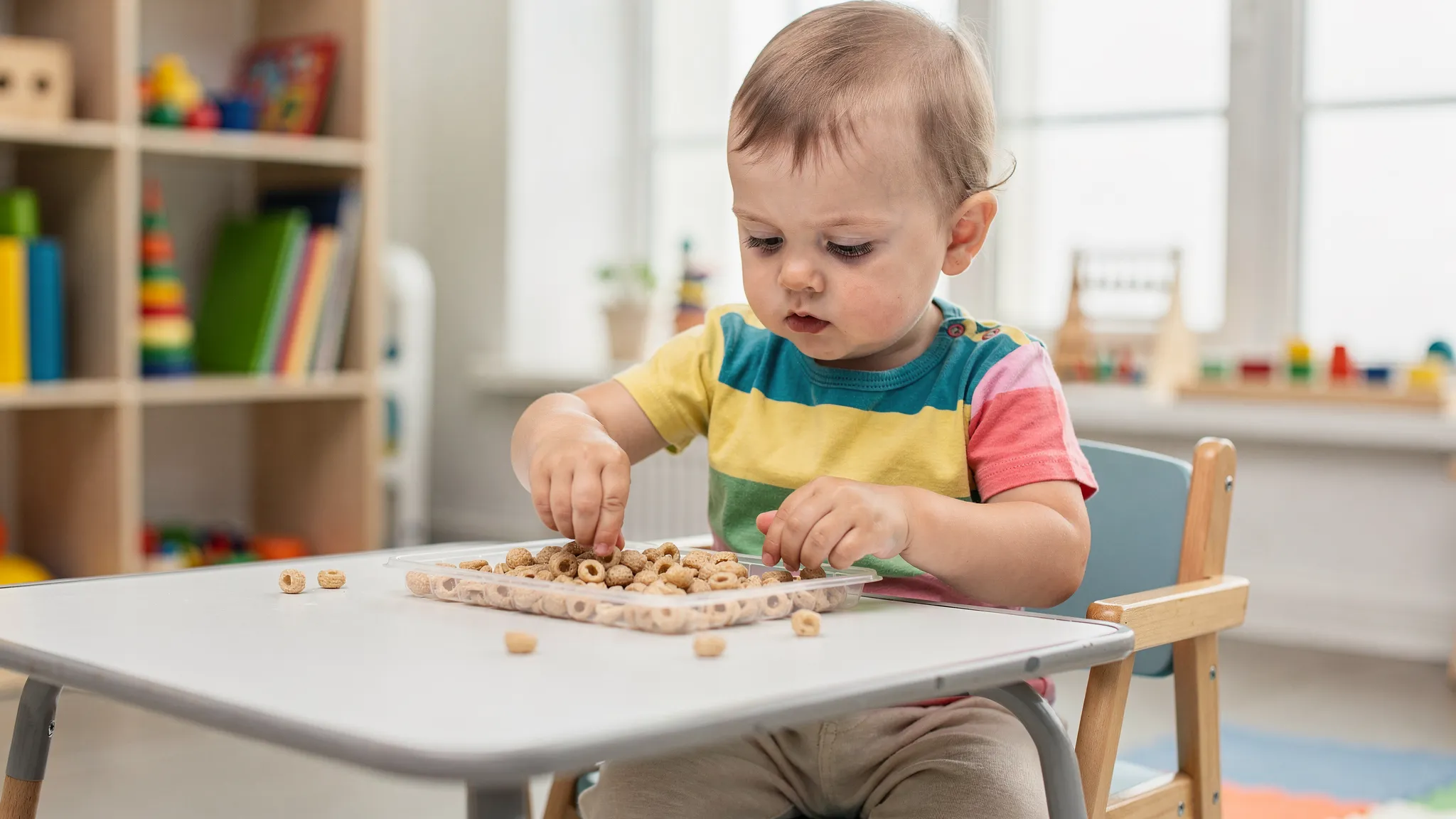
Age-by-age fine motor milestones
Every child develops at their own pace, however most follow a predictable sequence. Use this as a guide, not a test. If many items are consistently hard, consider an occupational therapy screening.
| Age range | What you will likely see | Try this at home |
|---|---|---|
| 0 to 3 months | Hands gradually open more, brings hands to mouth, briefly holds a rattle placed in hand | Hand-to-hand play at midline, gentle rattle play, tummy time to build shoulder stability |
| 4 to 6 months | Reaches for toys, grasps and shakes, transfers objects hand to hand | Soft crinkle books, lightweight toys to transfer, supported sitting with toys at chest height |
| 7 to 9 months | Purposeful release into your hand, bangs two toys together, rakes small items with fingers | Object-in, object-out games, large peg puzzles, container play |
| 10 to 12 months | Pincer grasp emerges, places items into containers, points with index finger | Snack pickup with safe-sized foods, post-and-play toys, finger isolation games |
| 12 to 18 months | Scribbles, stacks 2 to 3 blocks, uses spoon with some spills | Chunky crayons, simple stacking, pretend tea time with toddler spoon |
| 18 to 24 months | Stacks 4 to 6 blocks, turns pages one at a time, helps pull down zipper | Bead threading with large beads, open and close containers, coin bank play with large tokens |
| 2 to 3 years | Copies vertical and horizontal lines and a circle, snips paper, screws and unscrews lids | Playdough rolling and pinching, kid-safe scissors to snip, lacing cards |
| 3 to 4 years | Copies a cross, cuts along a straight line, buttons large buttons | Vertical drawing on an easel, clothespin games, simple board games with small pieces |
| 4 to 5 years | Copies a square, cuts out simple shapes, increasingly mature crayon or pencil grasp | Mazes and dot-to-dots, cut and paste crafts, using a fork with soft foods |
| 5 to 6 years | Copies a triangle, prints some letters and numbers, ties simple knots, consistent hand preference | Shoe-tying practice with a practice board, Lego builds with instructions, tracing and near-point copying |
For a deep dive on a key skill within this journey, explore our guide to the pincer grasp, including playful ideas you can use today: Pincer Grasp Activities Kids Love.
Red flags that deserve attention
A single delayed skill may not be cause for alarm, however patterns matter. Contact your pediatrician or an occupational therapist if you notice any of the following, especially if you see several together or if there is regression after previously gained skills.
- Persistent tightly fisted hands beyond about 3 months, or no reaching by 4 months
- No hand-to-hand transfer by 7 months
- Clear hand preference before 18 months, for example always using the right hand and ignoring the left
- No emerging pincer grasp by 12 months, difficulty picking up small items
- Not pointing by 14 months, limited use of index finger for exploration
- Little interest in scribbling by 15 to 18 months
- Difficulty stacking two blocks by 18 months, or four blocks by around 2 years
- Ongoing trouble with spoon use by 2 years, frequent dropping of utensils or toys
- Avoids or is distressed by messy play, strong tactile defensiveness that limits participation
- By 3 years, unable to copy a circle, snip paper, or string large beads
- By 4 to 5 years, very immature pencil grasp, tires quickly when drawing, cannot cut along a line
- Handwriting that is persistently illegible at 6 years despite practice, frequent letter reversals beyond early learning, or significant fatigue and hand pain
- General clumsiness that affects daily activities, difficulty using two hands together, or frequent dropping, which can be consistent with Developmental Coordination Disorder in some children
- Any loss of previously acquired skills at any age
The American Academy of Pediatrics encourages ongoing developmental surveillance and timely referral when concerns arise. Parents know their child best, and early support is linked with better outcomes. See the AAP’s caregiver resource on motor delays for additional context: HealthyChildren.org, Motor Delays. You can also review the CDC developmental milestones for age-specific guidance.
What actually builds fine motor skills
Fine motor development is not just about hands. It is a whole-child process influenced by stability, sensation, and meaningful practice.
- Posture and shoulder stability: Strong core and shoulders provide the base for precise finger work. Play on the tummy, crawl-through tunnels, and draw on vertical surfaces to build this base.
- Hand strength and arches: Squeezing playdough, using spray bottles, and wringing sponges strengthen the intrinsic hand muscles.
- Bilateral coordination: Many tasks need both hands, one stabilizing and one manipulating. Activities like opening jars, threading, and lacing support this.
- Visual motor integration: Eyes guide hands during tasks like mazes, puzzles, and copying shapes.
- Sensory processing: Comfort with different textures and movement supports participation. Gradual, positive exposure helps children who avoid messy play.
Therapist-approved home ideas, by goal
Choose a few ideas and repeat them in small doses most days. Keep practice fun and low pressure.
- For early grasp and release, 6 to 12 months: Container play with safe-sized objects, roll a ball back and forth, finger foods for pincer practice.
- For hand strength and dexterity, 18 months and up: Playdough hide-and-seek, clothespin races, squeeze-and-release water toys during bath time.
- For two-handed skills, 2 to 4 years: Lacing cards, string large beads, hold paper with one hand while snipping with the other.
- For pre-writing, 3 to 5 years: Vertical chalkboard drawing, big-to-small mazes, trace roads with a toy car then trace with a marker.
- For independence in dressing and feeding, 2 to 6 years: Practice zipping with the zipper started for them, sort buttons by size, serve yogurt with a child-sized spoon and fork.
Safety note: Always supervise closely. Avoid choking hazards for children under 3 years or for any child who still mouths objects.
If you want a quick primer on how occupational therapy approaches fine motor goals, see our overview: Occupational Therapy – A Brief Guide.
School readiness and handwriting
As children enter FS2 to Grade 1, handwriting is often emphasized. Look for these foundations before focusing on neatness:
- Stable posture with feet supported and shoulders relaxed
- Efficient pencil grasp that is comfortable and not overly tense
- Ability to copy basic shapes, cross, square, triangle, then letters
- Eye-hand coordination for near-point copying from a model
If handwriting is consistently slow or painful, an occupational therapist can analyze the underlying pieces and provide a plan that may include pencil grip training, visual motor exercises, and posture adjustments.
When fine motor issues appear in adults
Adults can also experience fine motor challenges due to stroke, brain injury, Parkinson’s disease, neuropathy, arthritis, or age-related changes. Signs include dropping items, buttoning difficulty, tremor interfering with feeding, or changes in handwriting. A personalized plan can combine occupational therapy for hand function, physiotherapy for strength and coordination, and psychological support where anxiety or mood changes are present. If speech, swallowing, or voice are affected, speech therapy complements motor rehabilitation.
How Bridges Speech Center can help
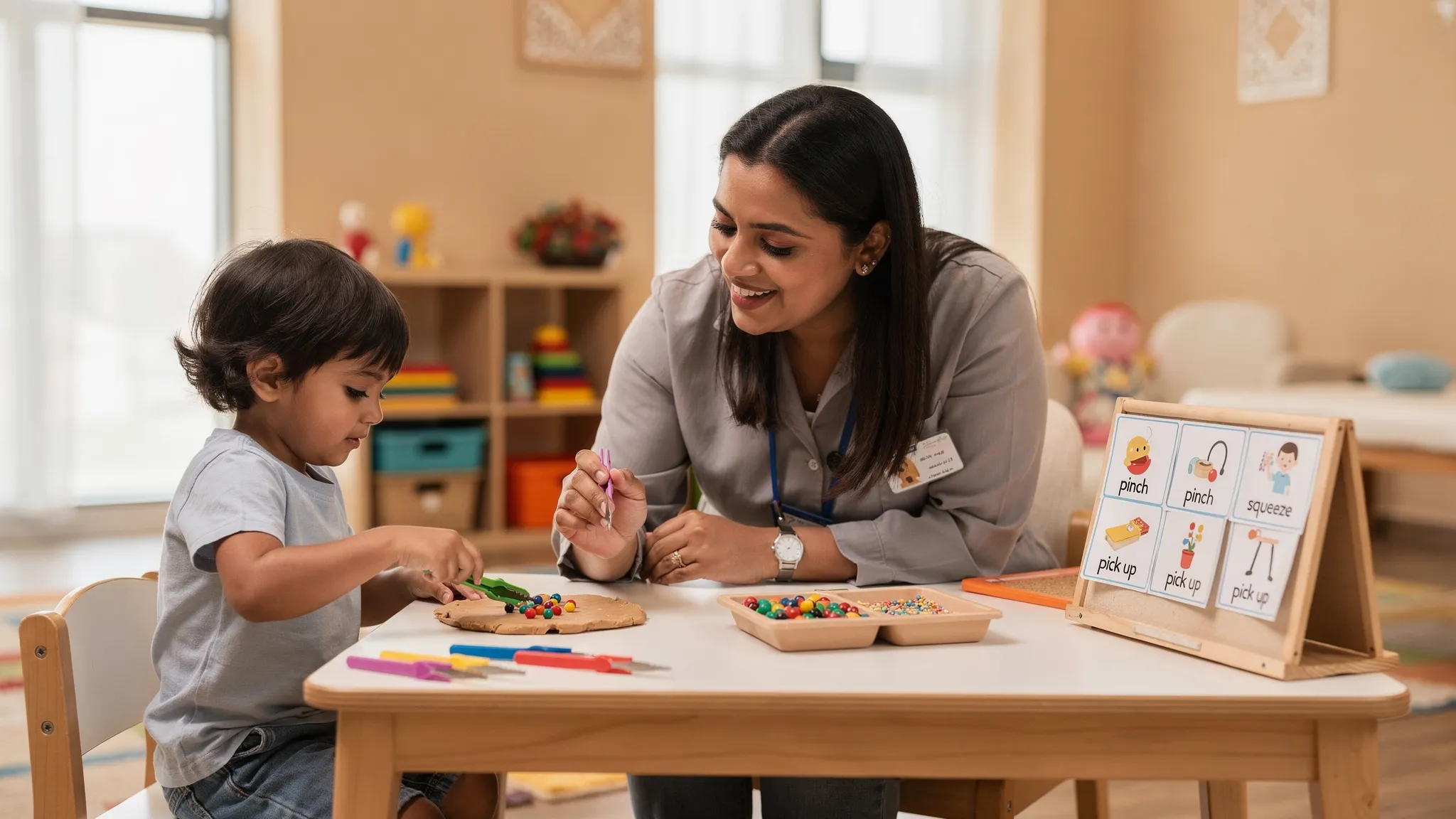
At Bridges Speech Center in Dubai, our multidisciplinary team supports children and adults with comprehensive, individualized care. Depending on your goals, your plan may include:
- Occupational therapy for fine motor development, daily living skills, sensory integration, and school or work accommodations
- Feeding therapy for utensil use, oral motor coordination, and mealtime independence
- Physiotherapy and rehabilitation where posture, strength, or neurological conditions affect hand control
- Clinical psychology and psychotherapy, including cognitive behavioral therapy, to support confidence, attention, and coping
- ABA and behavior therapy for learning routines and reducing task avoidance
- Home care therapy services, telehealth and online services, and structured parent involvement and training
We begin with a thorough assessment, set clear goals together, and use evidence-informed, play-based approaches that fit your home and school routines.
Frequently Asked Questions
What is the difference between gross motor and fine motor skills? Gross motor skills use large muscle groups for actions like sitting, walking, and jumping. Fine motor skills use small muscles of the hands and fingers for tasks like grasping, drawing, dressing, and feeding.
When should my child have a pincer grasp? Most children show an emerging pincer grasp around 9 to 10 months and a neat pincer by about 12 months. If it is not appearing, or if hand use is asymmetrical, book a screening.
Is early hand preference a concern? Consistent hand dominance typically appears between 4 and 6 years. A strong preference before 18 months can indicate weakness on the other side, and it is worth an occupational therapy evaluation.
Do screens affect fine motor development? Moderate, age-appropriate screen use combined with plenty of real play is usually fine. Heavy screen time can displace hands-on exploration that builds strength and coordination. Prioritize daily play with real objects and books.
How much should we practice at home? Short, frequent sessions work best, for example 10 to 15 minutes a day embedded in play or routines. Keep it fun, and stop before fatigue or frustration.
Which professional should we see first? Start with your pediatrician or family physician, and consult an occupational therapist for a focused fine motor assessment. Collaboration with physiotherapy, speech therapy, psychology, and feeding therapy is common when needs overlap.
Ready to check your child’s fine motor skills?
If your child is missing several milestones, if you see red flags, or if daily tasks are a struggle, early support can make a big difference. Bridges Speech Center offers occupational therapy, feeding therapy, physiotherapy, speech therapy, psychology, ABA, home care therapy, telehealth, and parent training in a safe, supportive environment.
Call us to book an assessment in Dubai today: +971-505226054 or 043581115. You can also learn more at bridgesspeechcenter.ae.
References and further reading: CDC developmental milestones, HealthyChildren.org, Motor Delays, AOTA resources.