Parents often hear the terms fine and gross motor skills during pediatric checkups or school meetings, then wonder what is typical and what needs support. If you are searching “fine gross motor skills” to understand what really matters day to day, this guide breaks it down in clear, practical language and shows how our multidisciplinary team in Dubai helps children and adults build stronger, more coordinated bodies for confident living.

Fine vs. gross motor skills, and why they both matter
Fine motor skills involve small, precise movements of the hands, fingers, and wrists. These skills power everyday tasks like buttoning, writing, using utensils, tying laces, manipulating zippers, and turning pages. Gross motor skills involve larger muscle groups in the trunk, arms, and legs, which enable sitting balance, crawling, walking, running, jumping, climbing, and ball play.
These two systems develop together. A child who has good core strength and balance, gross motor, usually has an easier time stabilizing the shoulder and wrist for handwriting and self care, fine motor. Strong foundations in both areas support attention, self confidence, safety on the playground, and independence at home and school. In adults, gross and fine motor control influence work tasks, fall risk, driving, fitness, and recovery after injury or illness.
At a glance
| Skill type | What it looks like | Everyday impact |
|---|---|---|
| Fine motor | Pincer grasp, in-hand manipulation, bilateral coordination, scissor control | Self feeding, dressing, handwriting, tool use |
| Gross motor | Postural control, balance, strength, coordination of both sides, agility | Walking, stairs, playground skills, sports, endurance |
Milestones, with flexible ranges
Children develop at different rates, and that is normal. The ranges below are typical windows, not deadlines. If you have concerns, especially if delays cluster across multiple areas, talk with your pediatrician or book an OT and physiotherapy screening.
| Age range | Fine motor, examples | Gross motor, examples |
|---|---|---|
| 9 to 12 months | Pincer grasp emerges, releases objects into a container | Pulls to stand, cruises, first independent steps appear |
| 18 to 24 months | Scribbles, stacks 4 to 6 blocks, turns pages | Runs, kicks ball, climbs onto furniture |
| 3 years | Copies a circle, strings large beads, uses child-safe scissors to snip | Pedals tricycle, jumps forward with both feet |
| 4 years | Copies cross and simple shapes, uses fork well | Hops on one foot, catches a bounced ball |
| 5 to 6 years | Prints some letters, cuts along a line, ties first knots | Skips, rides a bike with training wheels, coordinated ball skills |
For official milestone guidance and red flags, see the CDC’s Learn the Signs. Act Early resources, which are updated to reflect typical age windows and practical parent observations. CDC developmental milestones
Red flags that deserve a closer look
Use these signs as prompts to seek a professional opinion, not as a diagnosis.
- Persistent, frequent toe walking after age 2, especially with tight calves or tripping. Learn more in our overview of toe walking.
- Avoids playground equipment or rough and tumble games, appears fearful or fatigues quickly.
- Noticeably clumsy compared with peers, frequent falls, difficulty catching or throwing.
- Struggles with self care, buttons, zippers, utensils, tooth brushing, or handwriting beyond peers.
- Uses one hand exclusively very early before 18 months, or avoids using one side.
- Complains of hand pain during writing, or presses very hard or very lightly on the pencil.
- Sensory patterns that impact movement, avoids messy play, loud spaces, or certain textures, or seeks spinning and crashing constantly.
If you notice several of these for more than a couple of months, a developmental screen is appropriate. Conditions that can affect motor skills include developmental coordination disorder, DCD, autism, ADHD, dyspraxia, cerebral palsy, muscular or orthopedic issues, vision problems, and the effects of prematurity. Adults may experience motor challenges after stroke, brain injury, Parkinson’s disease, orthopedic surgery, or prolonged pain.
How motor skills interact with speech, feeding, and learning
- Core stability supports breath control and postural endurance, both important for clear speech and voice.
- Oral motor coordination influences chewing, swallowing, and articulation. Feeding therapy and speech therapy often work hand in hand with OT for posture and hand to mouth coordination.
- Sensory integration affects attention and behavior. When a child’s vestibular and proprioceptive systems are regulated, it is easier to sit, focus, and use fine motor control for handwriting and schoolwork.
At Bridges Speech Center, we combine speech therapy, occupational therapy, physiotherapy, ABA and behavior therapy, sensory integration, feeding therapy, and clinical psychology under one roof, with home care and telehealth options when appropriate. Your plan is individualized to your goals and daily routines.
Everyday activities parents can trust
Below are therapist tested ideas that build both fine and gross motor foundations using simple items. Adjust difficulty up or down to keep success high and frustration low, and supervise for safety.
- Kitchen helper: Wash and tear lettuce, scoop and pour measuring cups, stir batter, peel a banana, roll dough into snakes, then snip with child-safe scissors. Targets bilateral coordination, hand strength, wrist stability.
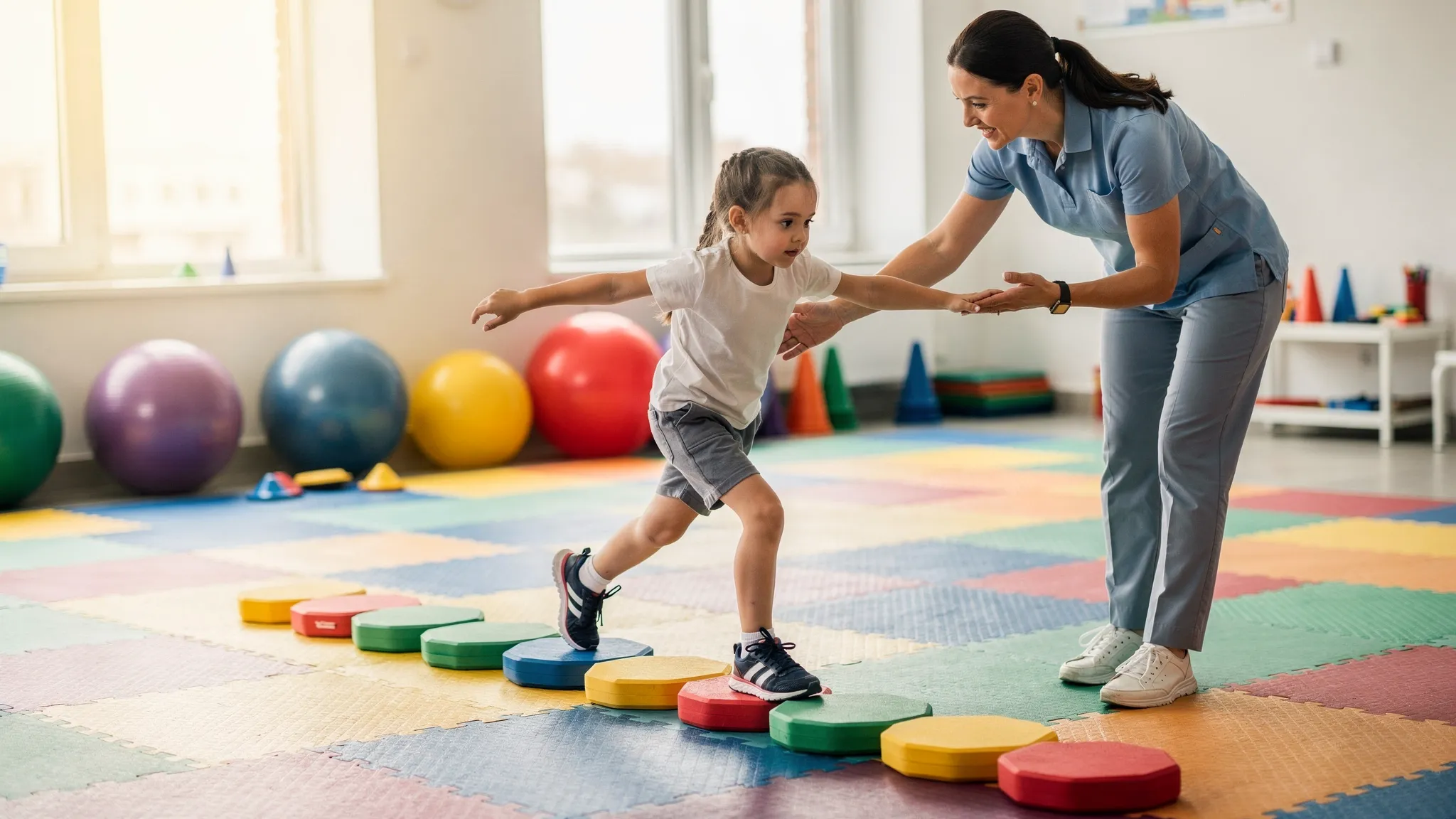
- Couch cushion course: Make stepping targets to practice big steps, balances, and safe jumps. Add an animal walk, bear, crab, frog hops. Targets balance, core, motor planning.
- Sticker road maps: Place dot stickers along a path to trace with a crayon or cotton swab dipped in paint. Targets precision and graded pressure.
- Laundry sort relay: Sort socks by size and color, then dash to drop them in labeled baskets. Targets visual scanning, bilateral hand use, endurance.
- Tape pull and save: Place painter’s tape “rescue lines” on small toys and have your child peel and free them. Targets pincer grasp and finger isolation.
- Balloon volleyball: Keep a balloon in the air using only forearms or a paper plate paddle. Targets hand eye coordination and shoulder stability.
- Playdough tool kit: Pinch, roll, press with a garlic press or plastic knife, hide beads and then find them with a pincer grasp. Targets intrinsic hand strength.
- Wall push ups and animal push ups: Push ups against the wall, then progress to kneeling animal push ups. Targets shoulder girdle stability for handwriting endurance.
- Painter’s tape scooter pull: If you have a scooter board, tie a rope and let your child pull a light weighted bag across the floor. Targets core and bilateral coordination.
- Desert friendly obstacle course: For UAE weather days, set up indoor stepping stones, tunnels from boxes, and a “cool down” yoga corner for poses like tree and cat cow. Targets balance, attention, self regulation.
For more hand skill ideas, explore our practical guide to pincer grasp activities.
A quick at home motor check
This mini check is not a diagnostic tool, it helps you decide whether to seek a screen.
- Can your 3 year old jump with both feet and land safely, copy a circle, and use a spoon with minimal spills most days?
- Can your 4 year old hop on one foot, catch a bounced ball, and copy a cross or simple person drawing?
- Can your 5 to 6 year old alternately skip steps, button large buttons, cut along a straight line, and write some letters with a relaxed grip?
- Does your child tire or avoid these tasks, or become unusually frustrated compared with peers?
- Do you notice persistent toe walking, asymmetry, or frequent falls?
If several answers raise concern, an occupational therapy and physiotherapy assessment is appropriate. We also screen sensory processing, vision referral needs, and environmental fit at home and school.
Dubai specific tips for strong motor development
- Beat the heat smartly. Rotate short indoor movement bursts with quiet fine motor play, then use early morning or evening outdoor time for park skills.
- Choose footwear that bends at the ball of the foot, and fits snugly at the heel. Shoes that are too stiff can limit ankle movement and balance.
- Desert sand is a natural balance trainer. Barefoot sand play builds intrinsic foot strength, important for arches and alignment.
- Hydration matters. Even mild dehydration reduces attention and endurance. Offer frequent water during active play.
- Balance screen time. The World Health Organization recommends lots of active play and limited sedentary screen time for young children. See WHO guidelines on physical activity for young children.
When other specialists may help
Most motor concerns are addressed by OT and physiotherapy, sometimes alongside speech therapy, ABA, or psychology for attention and behavior. A small number of children and adults benefit from medical or specialist input.
- Pediatrician or neurologist, for developmental coordination concerns, muscle tone differences, or regression.
- Orthopedist, for persistent gait differences, limb length issues, or joint pain.
- Optometrist or ophthalmologist, for visual tracking and depth perception concerns that affect coordination.
- Dermatology, for scars or skin conditions that limit range of motion or cause pain with movement. In Dubai, families sometimes explore premium skin laser treatments in Dubai to improve the appearance and pliability of certain scars under the care of qualified dermatologists. Discuss timing and suitability with your therapy and medical team.
How Bridges Speech Center supports your family
Bridges Speech Center in Dubai offers coordinated therapy for children and adults in a safe, supportive setting, in clinic, via telehealth, and through home care services when needed. Our team provides:
- Occupational therapy for fine motor skills, sensory integration, self care, and school participation.
- Physiotherapy and rehabilitation for strength, balance, mobility, orthopedic, neurological, pediatric and geriatric needs.
- Speech therapy for articulation, language, stuttering, oral motor and feeding therapy.
- ABA and behavior therapy to build attention, routines, and social skills alongside motor goals.
- Clinical psychology and psychotherapy, including cognitive behavioral therapy, for emotional and behavioral well being.
- Parent involvement and training so gains generalize to home and school.
A typical plan may include a joint OT and physiotherapy evaluation, a clear set of goals, two sessions per week for 8 to 12 weeks, home activities that fit your schedule, and progress reviews. If evaluations suggest additional support, such as speech therapy for feeding or articulation, or ABA for classroom routines, we coordinate seamlessly so your child has one integrated plan.
Adults recovering from stroke, brain injury, or orthopedic surgery benefit from targeted physiotherapy for mobility and balance, OT for hand function and daily living, and speech therapy for communication and swallowing. We also support adults with Parkinson’s disease, dementia, or progressive neurological conditions through individualized, research informed programs.
Getting started
- If you are unsure whether your child’s motor skills are on track, book a screening. Early support reduces frustration and builds confidence.
- If you are already on a waitlist elsewhere, ask us about short term coaching to keep progress moving at home.
- If in person sessions are tough right now, ask about telehealth, and our home care therapy services in Dubai.
Contact Bridges Speech Center to schedule an assessment and create a plan that fits your family. Call +971-505226054 or 043581115, or visit our website at bridgesspeechcenter.ae.
References and further reading
- CDC. Learn the Signs. Act Early, Developmental Milestones. CDC developmental milestones
- American Academy of Pediatrics, HealthyChildren.org. Developmental Coordination Disorder. What is DCD?
- World Health Organization. Guidelines on physical activity, sedentary behaviour and sleep for children under 5 years of age. WHO guidelines
Remember, milestones are guides, not grades. The best time to support motor skills is now, and small daily steps create meaningful change over time.