

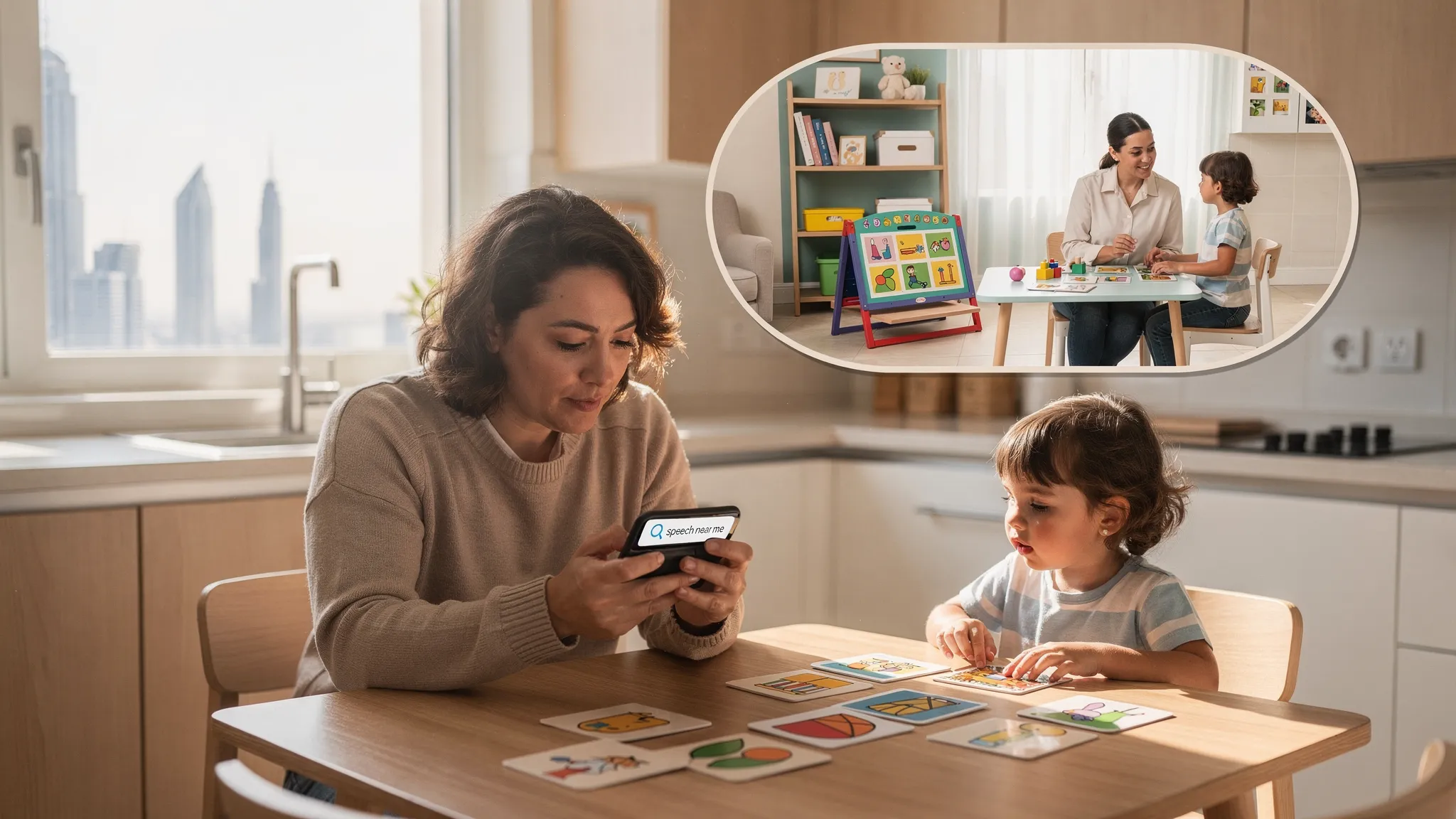
If you just typed speech near me in Dubai, you are likely scrolling through maps, reviews, and clinic pages trying to figure out who can actually help. This guide walks you through a simple, practical process to choose the right speech therapist for your needs, whether you are a parent looking for early support or an adult recovering communication skills after illness or injury.
Who this guide is for
- Parents concerned about speech delay, articulation challenges, stuttering, or social communication.
- Adults seeking help for dysarthria, aphasia, apraxia of speech, voice issues, accent modification, dementia-related communication, or swallowing concerns.
- Families considering home care, clinic visits, or telehealth in Dubai.
If you need a deeper dive on a specific topic, you can explore:
- Quick guide to selecting a speech therapy clinic in Dubai
- The importance of early intervention in speech and language development
- How to deal with speech delay in toddlers
- Adult speech therapy: improving communication and quality of life
A step-by-step plan to find the right “speech near me” care in Dubai
1) Define your goal and urgency
Clarify what you want to change first. For a toddler, it may be more words and clearer pronunciation. For an adult, it may be speaking louder, finding words after stroke, or safer swallowing. If there are red flags like choking, frequent coughing when eating, sudden speech changes, or a recent neurological event, treat this as urgent and book an assessment promptly.
2) Verify licensing and clinical experience
In Dubai, providers should be appropriately licensed. When you shortlist clinics, ask to see therapist credentials and confirm local licensing. You can also review general guidance from the Dubai Health Authority. Consider experience with your specific concern, for example stuttering, childhood apraxia, accent goals, stroke or Parkinson’s.
3) Match the specialization to your need
Not all speech-language pathologists focus on the same areas. Ask about targeted experience and methods relevant to your goals:
- Articulation clarity, motor planning, and play-based approaches for children. Learn about tactile-motor approaches like PROMPT therapy.
- Fluency strategies for stuttering.
- Language intervention for vocabulary, grammar, literacy support, and auditory processing.
- Adult neuro rehabilitation for aphasia, dysarthria, cognitive-communication, and swallowing. See adult speech therapy.
- Voice care and vocal hygiene if you use your voice professionally.
- AAC, which includes low-tech boards and high-tech speech-generating devices, if speech is very limited. Read about AAC devices and support.
- Feeding therapy if there is picky eating, sensory food aversion, gagging, or mealtime stress. Explore feeding therapy programs.
4) Choose the best setting for your routine
Some families need clinic-based sessions. Others benefit from home visits or telehealth. Use this quick comparison to decide what is most practical.
| Setting | Best for | Advantages | Considerations |
|---|---|---|---|
| Clinic | Access to full therapy tools and sensory spaces | Structured environment, fewer home distractions | Travel time, plan sessions around school or work |
| Home care | Generalization to real-life routines | Convenience, caregiver coaching in your actual environment | Space for activities, schedule windows |
| Telehealth | Follow-ups, mild to moderate goals, caregiver coaching | No commute, flexible scheduling | Requires stable internet and a quiet space |
Bridges Speech Center offers in-clinic care, home care therapy services, and telehealth, so you can combine settings if that fits your week.
5) Ask about assessment, goals, and progress tracking
A strong provider begins with a comprehensive assessment and gives you clear goals for the next 4 to 12 weeks. Ask how progress will be measured. You should hear practical outcomes like increased word counts, higher intelligibility in conversation, reduced stuttering tension, stronger voice volume, improved swallow safety, or easier mealtimes. You can also request a brief written plan so everyone, including caregivers and teachers, knows what to practice.
6) Clarify scheduling, location, and transport
Check travel times, parking, and public transport options at your preferred hour of the day. If you need after-school or evening slots, ask about flexibility in advance. For families balancing multiple therapies, a center that coordinates speech, occupational therapy, physiotherapy, and psychology can simplify scheduling.
7) Understand fees and insurance
Costs vary by session length and therapy type. Ask about assessment fees, typical treatment duration, and invoice documentation for insurance reimbursement. Many insurers cover allied health services depending on your plan. Confirm whether the clinic can provide detailed reports and receipts that align with your insurer’s requirements.
8) Review feedback and try a first session
Online reviews and personal referrals are helpful, but your own experience matters most. After the first session, you should understand the priority goals and what to do at home. You can evaluate how comfortable you or your child felt and whether the session was engaging and purposeful.
Smart ways to search “speech near me” in Dubai
- Use specific phrases in maps and search: speech therapist for stuttering Dubai, feeding therapist Al Karama, adult speech therapy near Business Bay.
- Filter by proximity, ratings, and photos of the therapy space. Read a few recent reviews to understand engagement style and communication.
- Ask your pediatrician, neurologist, family doctor, or school SENCO for recommendations.
- Check community groups for people of determination and parent networks in Dubai for lived experience feedback.
- Confirm licensing and clarify the clinician’s expertise with your exact concerns.
If sensory challenges are a concern, read more about sensory integration support, which often complements speech-language goals for regulation and attention.
What you can expect with Bridges Speech Center in Dubai
Bridges Speech Center provides care for children and adults with a team that includes speech-language pathologists, occupational therapists, physiotherapists, psychologists, and behavior therapists. Services include:
- Speech therapy for all ages, including articulation and language intervention, stuttering, apraxia of speech, dysarthria, aphasia, voice care, accent therapy, and cognitive-communication support.
- Feeding therapy programs for picky eating, sensory food aversion, and oral motor or swallowing challenges.
- Home care therapy services if you prefer therapy in your own environment.
- Sensory integration support, occupational therapy, physiotherapy and rehabilitation, ABA and behavior therapy, and clinical psychology and psychotherapy, including cognitive behavioral therapy.
- Telehealth and online services when travel is difficult.
- Parent involvement and training so gains translate into daily life.
If you are unsure where to start, our team can help you prioritize goals and choose clinic, home, or telehealth formats to fit your routine. To discuss your needs or schedule an assessment, you can call +971-505226054 or 043581115.
First-call script you can use today
When you contact a clinic, this quick script helps you get clear answers in one call.
- “I am looking for speech therapy near me in Dubai for my [child/adult]. Our main goals are [clearer speech, more words, stuttering support, voice, swallowing]. Do you treat this and how do you measure progress?”
- “What does the initial assessment include and how soon can we book?”
- “Do you offer clinic, home care, and telehealth options?”
- “How long are sessions and how often do you typically recommend?”
- “How do you involve parents or family, and what home practice will we receive?”
- “Can you provide reports or receipts for insurance?”
Red flags that warrant prompt assessment
- Sudden slurred speech, word-finding difficulty, or facial weakness.
- Coughing, choking, or wet voice during meals, especially after a recent illness or surgery.
- No words by 15 to 18 months, very limited words by age 2, or very unclear speech beyond age 3.
- Frequent loss of voice or ongoing hoarseness.
For developmental questions, you can also review early intervention guidance and toddler speech delay tips.
How clinics structure a strong start
A quality start typically includes:
- Intake and history, including medical, developmental, school, and family goals.
- Standardized testing or functional observation, plus informal play or conversation sampling.
- Same-day feedback that summarizes needs and short-term goals.
- A plan for session frequency, and home strategies that fit your schedule.
- Regular outcome tracking so you can see what is working.
If communication is minimal or speech is very hard to understand, ask whether augmentative and alternative communication will be considered. Learn how it works in practice: How AAC devices help.
Integrating support beyond speech
Many communication challenges benefit from coordinated care. For example, sensory processing differences can affect attention and behavior in sessions, feeding challenges may relate to oral motor coordination, and motor or posture issues may influence breath and voice. A center that offers speech therapy alongside occupational therapy, physiotherapy, ABA, and psychology can streamline your plan and reduce the number of separate visits.
If your child struggles with sensory regulation, you can read about our sensory integration therapy approach. If you suspect oral motor planning challenges, explore PROMPT therapy to see how tactile cues support clearer speech.
FAQs
How soon should I start if I am worried about my child’s speech? Sooner is better. Early assessment can identify whether a child needs therapy or simple home strategies. Small changes now can prevent larger gaps later.
Are home speech therapy sessions as effective as clinic sessions? Yes, when goals and activities are matched to the setting. Home care is excellent for generalizing skills in daily routines. Clinics offer specialized tools and fewer home distractions. Many families combine both.
How long are sessions and how many will we need? Session length and frequency depend on age, goals, and attention. Your therapist will recommend a plan after the assessment and will review progress with you at regular intervals.
Do you provide telehealth? Yes. Telehealth is well suited for caregiver coaching, follow-ups, and many child or adult goals. It requires a stable internet connection and a quiet space.
Do you support adults after stroke or with Parkinson’s disease? Yes, adult services include aphasia, dysarthria, apraxia of speech, cognitive-communication, voice, and swallowing therapy. See our overview of adult speech therapy.
Can you help with feeding challenges and picky eating? Yes. Our feeding therapy team addresses sensory food aversion, oral motor skills, and mealtime routines. Learn more about feeding therapy.
Do you offer accent therapy? Accent goals are available for adults who want clearer pronunciation and confidence in professional or social settings. We tailor plans to your communication needs.
Ready to stop searching for speech near me and start a targeted plan? Contact Bridges Speech Center to discuss your goals or book a comprehensive assessment.
- Phone or WhatsApp: +971-505226054
- Landline: 043581115
- Website: bridgesspeechcenter.ae
Our team supports children and adults with clinic sessions, home care therapy services, and telehealth across Dubai. We look forward to helping you or your child build communication, confidence, and everyday life skills.