

Motor skills are the “everyday movements” behind almost everything we do, from a toddler learning to stack blocks to a grandparent regaining balance after an illness. When motor skills development is on track, children can explore, play, learn, and care for themselves more independently. When it’s delayed or uneven, the challenges often show up in practical places first: messy handwriting, frequent falls, trouble using cutlery, difficulty dressing, or avoiding playground equipment.
This guide breaks down motor skill milestones (what many children can do at different ages) and shares simple, low-prep activities families can use at home. It’s not meant to replace an evaluation, but it will help you know what to look for and how to support progress.
What “motor skills development” actually includes
Motor skills are usually discussed in three overlapping categories:
Gross motor skills
These are big-body movements that use large muscle groups and support posture, balance, and mobility.
Examples: rolling, sitting, walking, jumping, climbing stairs, running, throwing, balance.
Fine motor skills
These are small, precise movements, usually involving hands and fingers, and they depend on stability in the shoulders, arms, and trunk.
Examples: picking up small objects, using a spoon, turning pages, drawing, buttoning, tying shoelaces.
Motor planning, coordination, and endurance
Many children (and adults) struggle not because they “lack strength,” but because the brain-body system has trouble:
- Planning the movement (motor planning)
- Timing and grading force (coordination)
- Repeating the movement without fatigue (endurance)
These areas are often addressed in occupational therapy and physiotherapy, and they can also be influenced by sensory processing, attention, vision, and confidence.
Why milestones matter (and why they are not a test)
Milestones help caregivers notice patterns over time. They can guide questions like:
- Is my child progressing steadily, even if slowly?
- Are skills emerging in a typical order?
- Is there a sudden loss of a skill?
The CDC’s developmental milestone checklists are a helpful reference because they’re written in parent-friendly language and updated to reflect current guidance.
Milestones are also affected by many normal factors, such as:
- Prematurity
- Opportunities for movement and play
- Temperament (cautious vs adventurous movers)
- Health, sleep, and nutrition
- Sensory sensitivities (avoiding certain textures, swings, or messy play)
If you’re unsure, it’s reasonable to seek a screening rather than “wait and see,” especially if daily routines are becoming stressful.
Motor milestones by age: what many children can do
Every child develops differently, but the patterns below can help you spot whether development seems generally on track.
| Age range | Common gross motor milestones | Common fine motor milestones | Daily-life examples you may notice |
|---|---|---|---|
| 0–6 months | Lifts head during tummy time, rolls (often tummy to back first), brings hands to midline | Reaches, briefly holds a toy, brings hands to mouth | Enjoys grasping a rattle, watches hands, tolerates short tummy time |
| 6–12 months | Sits without support, crawls or bottom-scoots, pulls to stand, may cruise | Transfers objects hand-to-hand, bangs toys, begins pincer grasp | Picks up finger foods, explores containers, starts self-feeding attempts |
| 12–24 months | Walks independently, begins running, climbs onto furniture | Releases objects into a container, turns pages, scribbles | Uses spoon with spills, stacks a few blocks, starts helping in dressing |
| 2–3 years | Jumps with both feet, kicks a ball, climbs stairs with support | Builds taller towers, snips with child scissors (with help), strings large beads | More independent feeding, attempts simple clothing tasks |
| 3–4 years | Pedals a tricycle, stands briefly on one foot, goes upstairs alternating feet | Draws simple shapes, uses tongs/tweezers with practice, starts using buttons | Better utensil use, improved dressing tolerance, early pre-writing skills |
| 4–5 years | Hops, improves balance, catches a large ball more reliably | Copies some letters/shapes, uses scissors along a line, improved grip endurance | More independent toileting routines, better classroom tool use |
| 5–7 years | Skips, jumps further, stronger postural control for sitting/learning | Writes with more control, ties shoelaces (emerging), better in-hand manipulation | Faster dressing, better handwriting stamina, more confident playground play |
If you’d like a deeper dive specifically on big-body skills, you can also read Bridges’ guide on gross motor skills.
Red flags that merit a screening
A single missed milestone doesn’t automatically mean there’s a disorder, but these patterns are worth discussing with a pediatrician or therapist:
- Persistent “floppy” body tone or extreme stiffness
- Frequent falling beyond what seems typical for age, or avoiding movement due to fear
- Significant hand preference before age 2 (may indicate weakness or limited use on one side)
- Difficulty learning new movements (for example, cannot copy simple actions even with practice)
- Ongoing trouble with self-care skills compared to peers (utensils, dressing, toileting routines)
- Regression, loss of previously gained skills (this should be addressed promptly)
In school-age children, motor concerns often show up as messy handwriting, slow output, trouble cutting, or fatigue during desk tasks.
Activities that build motor skills without feeling like “therapy”
The most effective home activities are usually the ones that:
- Are short (5–15 minutes)
- Repeat often (a few times a week)
- Have a clear purpose (a “job” or game goal)
- Can be adjusted up or down easily
Below is an activity bank organized by skill area and age. Choose one or two, do them consistently, then rotate.
1) For babies (0–12 months): foundations first
Babies build motor control from the center outward. That means head control, trunk stability, and midline play support later hand skills.
Try:
- Tummy time variations: short, frequent sessions with a toy placed slightly to the side to encourage weight shifting.
- Side-lying play: helps hands come together at midline and reduces “arching.”
- Reach-and-grab games: hold a toy at shoulder height (not too high) to promote controlled reaching.
If tummy time is a daily battle or your baby seems very stiff or very floppy, a physiotherapy or occupational therapy screening can be helpful.
2) Ages 1–2: climbing, carrying, and container play
Toddlers learn by repeating. Many “motor skill activities” at this age are simply safe ways to climb and explore.
Try:
- Push and pull: push a laundry basket with a few books inside, or pull a toy on a string to build leg strength and coordination.
- Container play: drop toys into a box, take them out, repeat. This builds release control and early problem-solving.
- Ball basics: roll a ball back and forth, then progress to gentle underhand toss into a basket.
Keep sessions brief and positive. The goal is confidence, not perfection.
3) Ages 2–3: balance + hands working together
This is a key window for bilateral coordination (using two hands together, each doing a different job), which later supports cutting, dressing, and writing.
Try:
- Sticker rescue: place stickers on a table or tray and have your child peel them and place them on paper. Great for finger control.
- Play-Doh tools: rolling pins, child-safe scissors, and cookie cutters build hand strength and coordination.
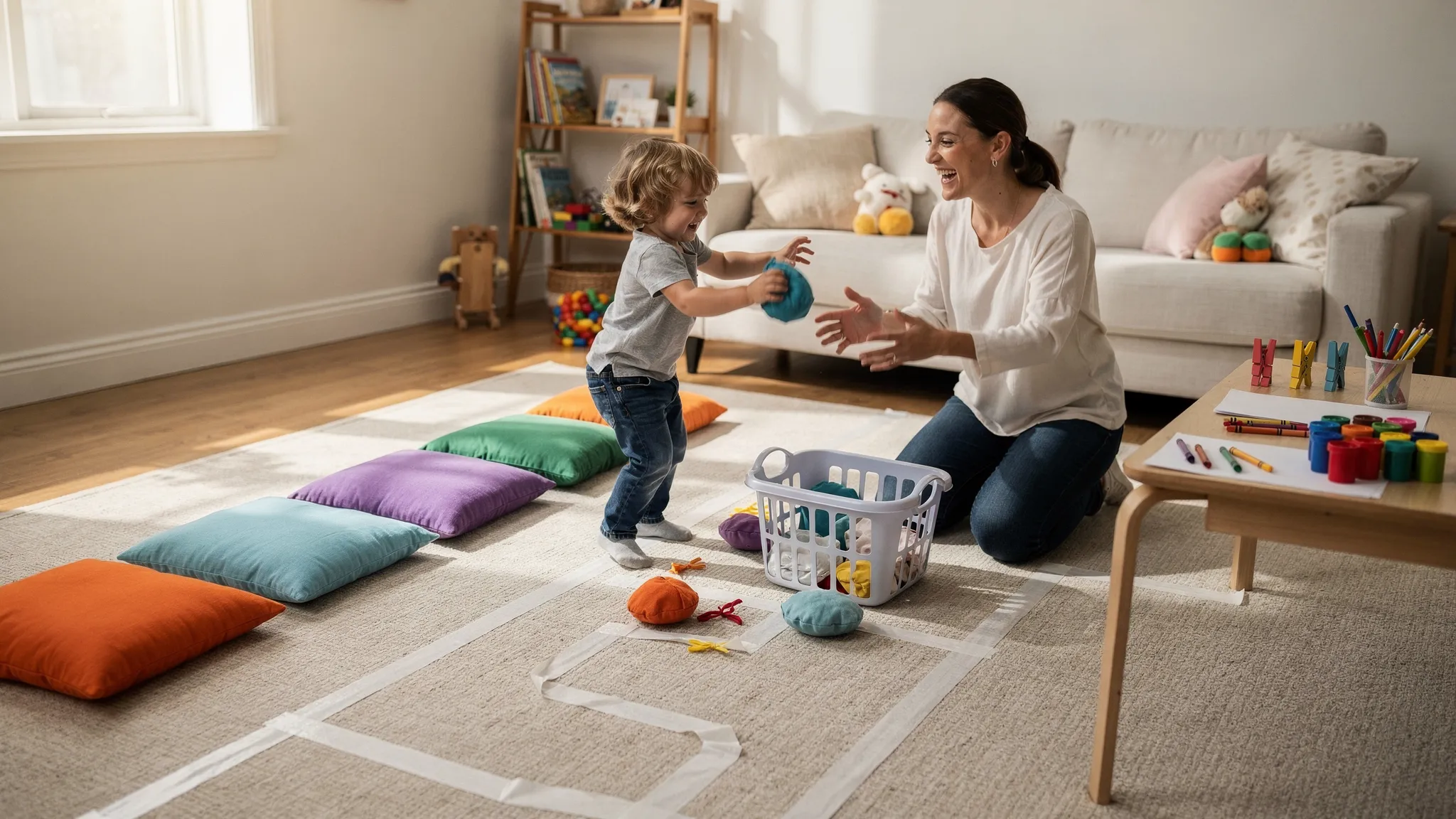
- Obstacle path: pillows to step over, a taped line to walk on, then “crash” onto a cushion. Repeat 3–5 rounds.
For children who struggle with thumb and finger control, you may also like Bridges’ pincer-focused ideas in pincer grasp activities kids love.
4) Ages 3–5: pre-writing, posture, and precision
When preschoolers are asked to color, draw, and start letter shapes, it’s common to see frustration if core stability, grip, or coordination are still developing.
Try:
- Vertical surface coloring: tape paper to a wall or easel. This encourages better wrist position and shoulder stability.
- Clothespin games: clip cards onto a line or clip pompoms onto a container edge.
- Scissor “snip” practice: start with snipping playdough “snakes,” then progress to cutting thick paper strips.
If you suspect coordination challenges, you may find it helpful to review hand-eye coordination in child development.
5) Ages 5–8: handwriting stamina and motor planning
In early primary years, the main barriers are often endurance (hand fatigue), motor planning (forming letters consistently), and postural control (slumping at the desk).
Try:
- Short “writing bursts”: 2 minutes of writing, then 1 minute of movement (wall push-ups, animal walks), repeat.
- Fine motor “toolbox”: lacing cards, small LEGO builds, origami folding, and simple bead patterns.
- Timed functional tasks: “Can you button 3 buttons before the song ends?” Keep it playful and low pressure.
If writing is the main concern, pairing hand skill work with posture and seating adjustments can make a big difference.
Skill-focused activity ideas (quick matching guide)
Use this table when you know the challenge (for example, “my child avoids playgrounds” or “buttons are hard”) and want targeted ideas.
| Skill area | What it affects | Home activities that usually help |
|---|---|---|
| Core strength and postural stability | Sitting for learning, hand control, balance | Animal walks, wheelbarrow walks (supported), wall sits, climbing play |
| Bilateral coordination | Cutting, catching, dressing, opening containers | Tearing paper for crafts, lacing, rolling dough with two hands, stringing beads |
| Hand strength and endurance | Pencil control, utensil use, fatigue | Play-Doh resistance tools, clothespins, squeeze bottles in bath time |
| Finger isolation and dexterity | Buttons, zippers, neat writing | Tweezers games, sticker peeling, coin drop into a slot |
| Balance and coordination | Running, stairs, sports confidence | Tape-line walking, hopscotch, stepping stones with cushions |
| Motor planning | Learning new movement sequences | Simple obstacle courses, dance routines, “copy my moves” games |
When motor delays affect behavior, attention, or confidence
Motor challenges don’t always look like “poor movement.” Sometimes they look like:
- Avoiding crafts or refusing to write
- Meltdowns during dressing or toothbrushing
- “Clumsy” play that leads to social withdrawal
- Over-reliance on adults for tasks the child wants to do independently
In these cases, therapy often focuses on both the motor skill and the emotional piece: building predictable routines, breaking tasks into achievable steps, and helping the child experience success.
Motor skills across the lifespan: adults need milestones too
Motor skills development isn’t only a childhood topic. Adults may need rehabilitation and re-training after:
- Stroke
- Traumatic brain injury
- Parkinson’s disease and other neurological conditions
- Orthopedic injuries or surgeries
- Chronic pain that changes movement patterns
In adults, “milestones” are typically functional goals such as:
- Walking safely without falls
- Using a hand for cooking or grooming again
- Improving balance for stairs and community mobility
- Regaining work-related endurance
Task-specific practice matters. A therapist may build a graded plan that starts with supported movement and progresses toward real-life tasks at home and in the community.
How occupational therapy and physiotherapy support motor skill growth
A high-quality motor plan usually includes:
- Assessment: identifying whether the main issue is strength, coordination, motor planning, balance, sensory processing, or a combination.
- Functional goals: skills that matter in daily life (feeding, dressing, classroom participation, mobility).
- Progression: making tasks slightly harder over time without overwhelming the person.
- Carryover: simple home practice so improvement continues between sessions.
At Bridges Speech Center, care can include occupational therapy and physiotherapy, and when appropriate, coordination with speech therapy, feeding therapy, ABA/behavior support, and psychology so that motor progress translates into real-life confidence and independence.
Getting support in Dubai: practical next steps
If you’re concerned about your child’s motor skills (or your own), consider these steps:
- Track what you see for 2 weeks: What’s easy, what’s avoided, what causes frustration?
- Bring specific examples to a clinician (videos can help if you have them).
- Ask for a screening rather than waiting for the problem to “get big.” Early support often means faster progress and fewer secondary challenges.
To explore professional support, you can learn more about Bridges’ occupational therapy approach in Occupational Therapy – A Brief Guide or contact the clinic directly through Bridges Speech Center. The center also provides home care and telehealth options, which can be helpful for busy families or adults with mobility limitations.
A final note for parents and caregivers
You don’t need a perfect home program to support motor skills development. Consistent, playful practice and the right level of challenge are what matter most. If your child (or you) is working very hard just to keep up with everyday tasks, it’s a sign that an individualized plan may help.
If you’d like a professional screening and a clear plan, Bridges Speech Center in Dubai offers individualized therapy programs across speech, occupational therapy, physiotherapy, and psychological support, with strong caregiver involvement to help skills carry over into daily life.