Families often hear about DMI during evaluations for motor delays and quickly search what is DMI therapy to understand if it fits their child’s needs. This guide explains the approach in parent friendly language, shows how it supports real life skills, and outlines how Bridges Speech Center delivers DMI therapy Dubai within a coordinated care plan.

What is DMI therapy?
What is DMI therapy? It stands for Dynamic Movement Intervention, a child centered physiotherapy method that uses precise hands on support and graded challenges to spark active movement, better posture, and improved balance. If you have wondered what is DMI therapy and why it is talked about so much, think of it as structured play that gently pushes a child to find stability during real movement, not just while holding positions.
At its core, what is DMI therapy about is neuroplastic learning. The therapist sets up short tasks that require the child to activate trunk and postural muscles, then quickly changes the challenge so the brain gets many high quality repetitions. Over time this builds automatic responses like righting, protective reactions, and smoother transitions.
Bridges Speech Center provides comprehensive DMI therapy within an integrated pediatric program. You can also read more under Dynamic Movement Intervention.
What happens in a typical session
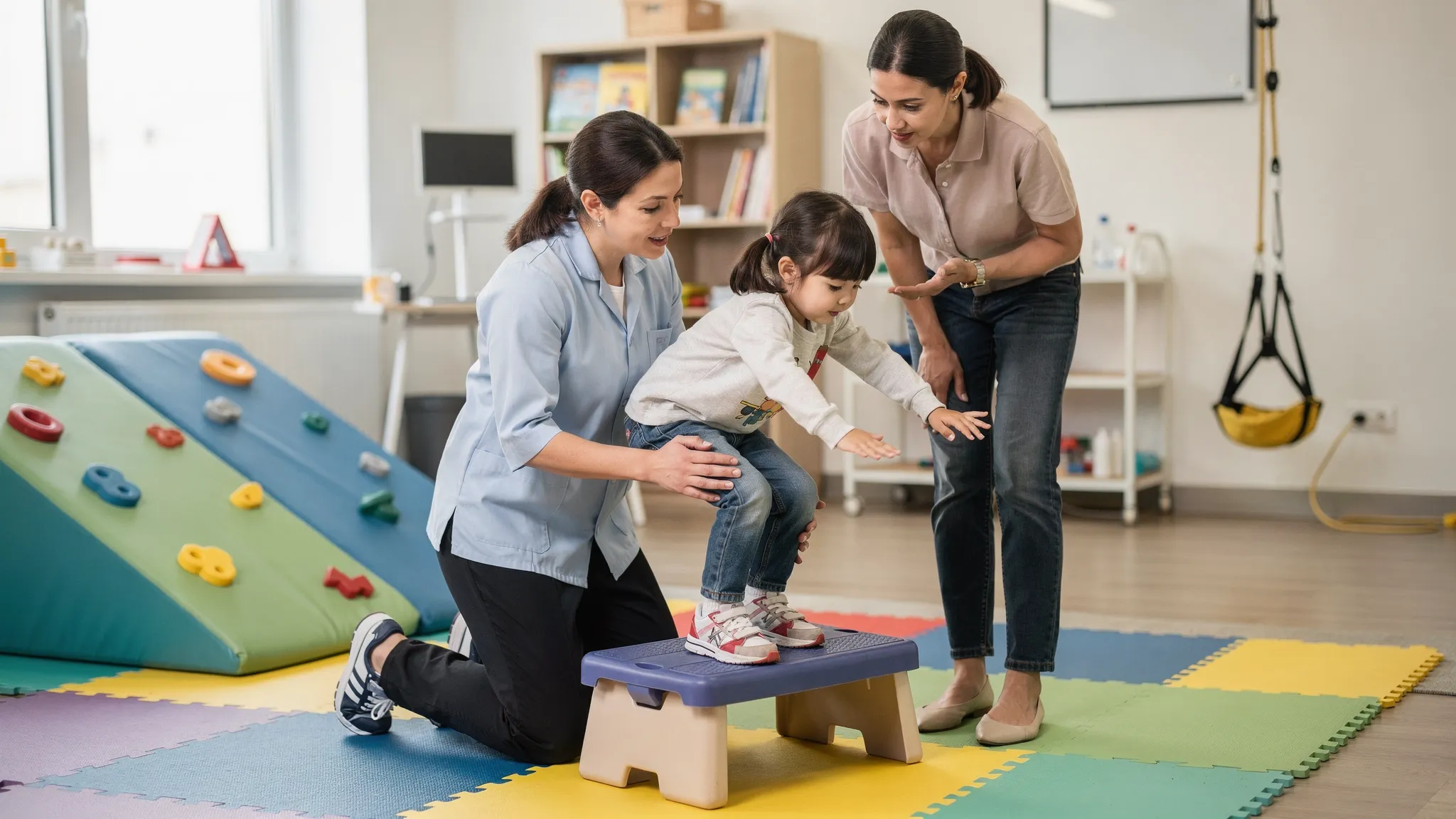
So what is DMI therapy session flow like in practice? A session often runs 45 to 60 minutes and includes several circuits tailored to your child’s goals.
- Short, high repetition tasks to elicit head control, midline orientation, and protective extension
- Graded support, often at more distal points like legs or arms, so the child initiates core stability
- Transitions like tall kneel to half kneel to stand, step ups, and controlled descents
- Balance challenges on compliant surfaces with quick rest breaks
- Parent coaching on 2 to 3 simple home tasks
Parents often ask clinicians what is DMI therapy for babies or toddlers. Many infants with low tone can start as soon as they are medically cleared, because tasks are scaled to developmental level.
Who can benefit
If you are weighing physiotherapy options and still asking what is DMI therapy best suited for, here are common profiles that respond well:
- Hypotonia or global developmental delay
- Cerebral palsy, hemiplegia, or prematurity related motor delays
- Down syndrome with ligament laxity and delayed milestones
- Torticollis, asymmetry, and poor postural reactions
- Toe walking and balance issues
DMI therapy Dubai is frequently paired with sensory integration and occupational therapy to support attention, coordination, and daily living skills.
How DMI supports development beyond movement
You might still wonder what is DMI therapy doing for communication or learning. Movement and posture set the stage for attention and breath control, which influence speech production and feeding. Better trunk stability can translate into improved breath support for voice, and calmer arousal for language learning. That is why families often combine DMI with speech therapy or book with a senior Speech therapist when oral motor and feeding goals are present.
Dynamic Movement Intervention also taps vestibular and proprioceptive systems in purposeful ways. This helps children register body position, organize movement, and participate more confidently at home and school.
Common goals and how progress is measured
Understanding what is DMI therapy includes knowing how we set goals and track gains. Here are examples of targets and simple ways therapists measure change.
| Goal area | Example therapy target | How progress is measured |
|---|---|---|
| Head and trunk control | Maintain midline head for 10 seconds during sitting | Seconds held, number of losses of balance |
| Transitions | Move from floor to stand with support at knees | Assistance level, time to complete, number of attempts |
| Balance | Stand on foam for 15 seconds without stepping off | Time in balance, step offs, postural sway notes |
| Gait | Take 10 steps with improved step symmetry | Step count, symmetry notes, path deviation |
| Protective reactions | Reach out hand when losing balance during side push | Reaction time, successful recoveries |
| Endurance | Complete 5 short circuits with minimal fatigue | Circuits completed, quality ratings, need for rest |
The question what is DMI therapy good for often comes up during goal setting. It is most effective for automatic postural control and functional movement that supports daily activities like playing on the floor, climbing a step, or getting up from a chair.
DMI therapy Dubai at Bridges Speech Center
Bridges Speech Center delivers DMI therapy Dubai through trained pediatric physiotherapists who coordinate with occupational and speech clinicians when needed. Sessions are personalized, family centered, and available in clinic or through home care when appropriate. If you are searching what is DMI therapy in Dubai for your infant or toddler, our team offers an evaluation to confirm fit and set a clear home carryover plan.
- Learn more about our DMI therapy
- Read about Dynamic Movement Intervention
- Meet a senior Speech therapist
- Explore Speech therapy Dubai for integrated communication support
What to expect at your first visit
Understanding what is DMI therapy helps you prepare. Your first appointment usually includes a brief intake, functional movement screening, and trial activities to see how your child responds to graded support. You will leave with a starter home plan, safety tips, and a recommended schedule based on goals. Frequency varies by child, often two to three sessions weekly early on, then tapering as skills generalize.
Safety, training, and how DMI compares
Parents sometimes ask what is DMI therapy compared to other pediatric physiotherapy options. DMI shares a motor learning foundation with several methods, but it places strong emphasis on eliciting automatic postural reactions during active tasks with carefully chosen support points. Safety is prioritized with skilled handling, close spotting, and task scaling to the child’s current capacity.
Home carryover that boosts results
Results improve when families practice short, safe activities between visits. After your therapist shows you how, you might work on simple weight shifts during floor play, step to targets on a low surface, or tall kneel holds during story time. Consistency and positive feedback matter.
How DMI and speech therapy complement each other
Better postural stability and breath control can make speech sound production clearer. If your child has both motor delay and communication goals, pairing DMI with speech therapy can amplify gains. Families searching what is DMI therapy for communication quickly learn it is not speech therapy, but it creates the physical foundation that supports speech breathing and attention. If you need guidance on coordination across services, a senior Speech therapist can help align practice routines at home.
Key takeaways
- Dynamic Movement Intervention is an active, goal driven method that builds automatic postural control and functional movement
- What is DMI therapy best at is improving transitions, balance, and gait that support real life tasks
- DMI therapy Dubai is available at Bridges Speech Center with coordinated occupational and speech input when needed
- Parent coaching and short daily practice accelerate progress
Ready to help your child move with confidence
Now that you know what is DMI therapy and how it supports development, you can take the next step. Book an evaluation at Bridges Speech Center to see how Dynamic Movement Intervention fits your child’s goals. Learn more about our DMI therapy and integrated Speech therapy Dubai.