
A child’s sports injury can feel scary for families. Parents worry about pain, missed school, missed sports and long-term problems. Kids also worry about losing their place on the team or getting hurt again.
The goal of Sports Injury Rehabilitation is not only to “heal” an injury. It is to help a child return to play with strength, confidence, good movement habits and a lower risk of re-injury.
At Bridges Speech Center in Dubai our team supports children through physiotherapy rehabilitation and coordinated care. When needed we also support communication attention and confidence through speech therapy Dubai services.
Table of Contents
ToggleWhy kids need a different approach than adults
Children are not small adults. Their bones, tendons and growth plates respond differently to stress. They may also struggle to explain symptoms clearly.
Effective Sports Injury Rehabilitation for kids considers:
- Growth and development (including coordination and rapid growth spurts)
- School demands and fatigue
- Sport-specific skills and training load
- Emotional readiness and fear of re-injury
When families rush the process they often see pain return. A smart Sports Injury Rehabilitation plan builds capacity step by step.
Common sports injuries in children and what they affect
Kids can be injured by contact falls, poor landing mechanics or repeating the same movement too often.
Frequent issues include ankle sprains, knee pain, muscle strains, tendon irritation and fractures. Overuse injuries can show up during seasons with intense training and little rest.
If you want to understand care pathways for sports injuries in children you can explore Bridges’ dedicated page on sports injuries in children.
The 4 phases of Sports Injury Rehabilitation for safe return to play
Most pediatric recovery plans follow phases. The pace depends on the diagnosis, pain level medical guidance and how well the child responds.
Phase 1: Protect calm symptoms and keep safe movement
Early Sports Injury Rehabilitation focuses on protection, swelling control and gentle movement. For some injuries rest is needed. For others early safe activity helps prevent stiffness.
A good plan also keeps the child active in other ways. That might mean upper-body training swimming or non-impact cardio depending on what is safe.
Phase 2: Restore mobility coordination and basic strength
In this stage Sports Injury Rehabilitation targets range of motion joint control and muscle activation.
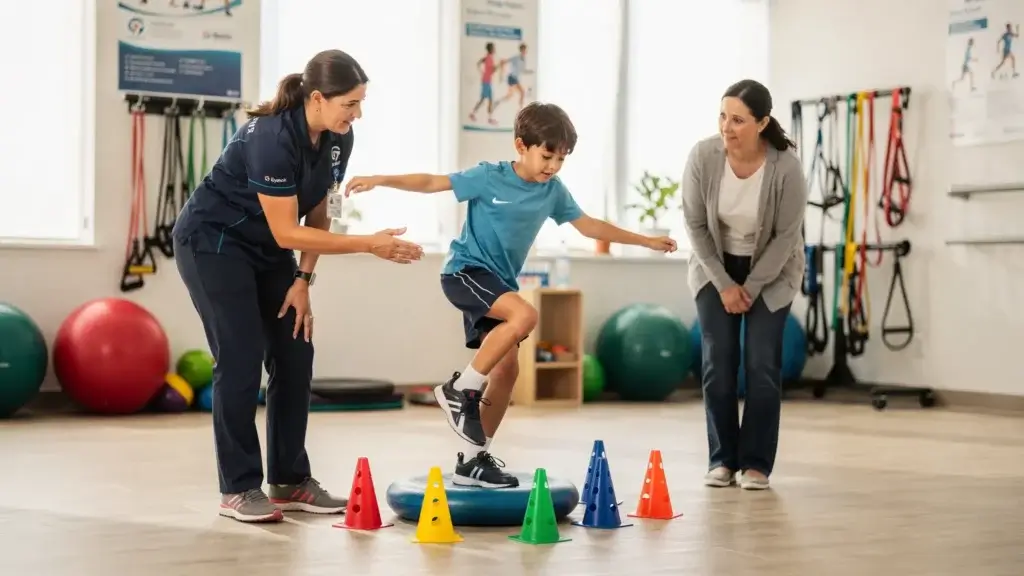
For kids this often looks like play-based movement training. They learn how to squat step land and balance with good alignment.
Phase 3: Build capacity for sport demands
As pain decreases the focus shifts toward progressive loading. That includes strength, power, agility and endurance.
This phase is the heart of Sports Injury Rehabilitation because it prepares tissues for real sport stress.
Phase 4: Return to sport with testing and confidence
Return to play should not be based only on time. A safer approach uses objective checks.
Return-to-sport Sports Injury Rehabilitation may include hop tests, balance control, repeated sprint tolerance and sport-specific drills.
It should also include mental readiness. Fear can change movement patterns and raise injury risk. This is why many modern programs combine physical training with confidence-building strategies.
Sports Injury Rehabilitation checklist: what “ready” often looks like
No single checklist fits every injury. Still many return-to-play decisions share similar markers.
Return-to-play area | What the therapist checks | Why it matters |
Pain and swelling | Low or none during daily activity and training | Persistent swelling often means overload |
Mobility | Near-normal range of motion compared to the other side | Stiffness can change mechanics |
Strength | Key muscles can tolerate progressive resistance | Weakness increases compensation |
Balance and control | Single-leg stability and clean landing mechanics | Poor control links to re-injury |
Sport skills | Dribbling cutting jumping sprinting in safe progression | Sport demands are specific |
Confidence | Child trusts the body and follows the plan | Fear can increase risk |
A physiotherapist should guide these checks during Sports Injury Rehabilitation.
Practical tips parents can use at home (without overdoing it)
Home support improves outcomes when it matches the clinic plan. The key is consistency not intensity.
Keep the home plan short and repeatable
Most children do better with 10 to 20 minutes of focused practice than long sessions.
Use “pain rules”
During Sports Injury Rehabilitation it is common to allow mild discomfort. Pain that rises sharply causes limping or lasts into the next day usually means the load was too high.
Protect sleep and nutrition
Sleep is a recovery tool. So is protein and hydration. For teens energy intake matters because under-fueling can slow healing.
Watch movement quality not only effort
If a child’s knee collapses inward during squats or landings they may be strong enough to do the movement but not controlled enough to do it safely.
Consider home-based physiotherapy when it helps
Some families need in-home support due to busy schedules, school routines or a child who performs better in familiar environments. Ask if home care is appropriate for your child’s Sports Injury Rehabilitation plan.
Latest trends in pediatric Sports Injury Rehabilitation (2026)
Sports medicine is moving toward more personalized data-informed care.
1) Return-to-sport testing instead of time-only clearance
Clinics increasingly use functional tests to reduce guesswork. This supports safer decision-making in Sports Injury Rehabilitation.
2) Better load management for young athletes
Coaches and therapists are paying more attention to weekly training spikes. Sudden increases in volume are a common setup for overuse injuries.
3) Tele-rehab check-ins for follow-through
Hybrid models can help families stay consistent. When travel is hard some sessions can be reviewed online with technique corrections.
4) Whole-child support including confidence communication and focus
After injury kids may avoid activity, become anxious or struggle to speak up about pain. Some children need help with self-advocacy or coping skills.
This is where multidisciplinary care matters. At Bridges Speech Center families can access physiotherapy plus supportive services like speech therapy when communication confidence or swallowing concerns exist. For families searching locally for speech therapy Dubai support you can explore Speech therapy Dubai options and meet the team.
When to seek professional help
You should book an assessment if:
- Pain lasts more than a few days after a twist fall or collision
- Your child limps avoids stairs or stops using an arm
- Swelling or bruising is significant
- Pain keeps returning when training resumes
You can learn more about integrated care at Bridges Speech Center through our speech therapy services and our broader pediatric rehabilitation approach.
If your child’s recovery also includes speech clarity voice changes breathing control or confidence in speaking (sometimes seen after injury stress or time away from peers) a licensed speech therapist can support communication goals alongside physical recovery.
Conclusion: help your child return stronger not just faster
Safe return to sport is a process. The best outcomes come from a structured Sports Injury Rehabilitation plan that restores movement, builds strength, improves control and supports confidence.
If you are in Dubai and your child needs assessment for pain recurring injuries or return-to-play planning Bridges Speech Center can help with physiotherapy and coordinated care. We also support families who need speech therapy Dubai services as part of whole-child recovery.
To get started, book an evaluation through contact us.
Frequently Asked Questions
How long does Sports Injury Rehabilitation take for kids?
Sports Injury Rehabilitation timelines depend on the injury type severity and how consistently the plan is followed. Many children improve steadily with structured progression but clearance should be based on function not only time.
Can my child play through pain during Sports Injury Rehabilitation?
Mild discomfort may be acceptable in some stages but sharp pain, limping swelling or pain that lasts into the next day usually means the activity level is too high and needs adjustment.
What should parents avoid during Sports Injury Rehabilitation?
Avoid rushing back to matches, skipping rehab steps or adding extra training outside the plan. Overloading too early is a common cause of setbacks.
When is it safe to return to sport after Sports Injury Rehabilitation?
It is usually safer when your child has near-normal strength and mobility, good balance and landing control, can complete sport-specific drills and feels confident. A physiotherapist should confirm readiness.