
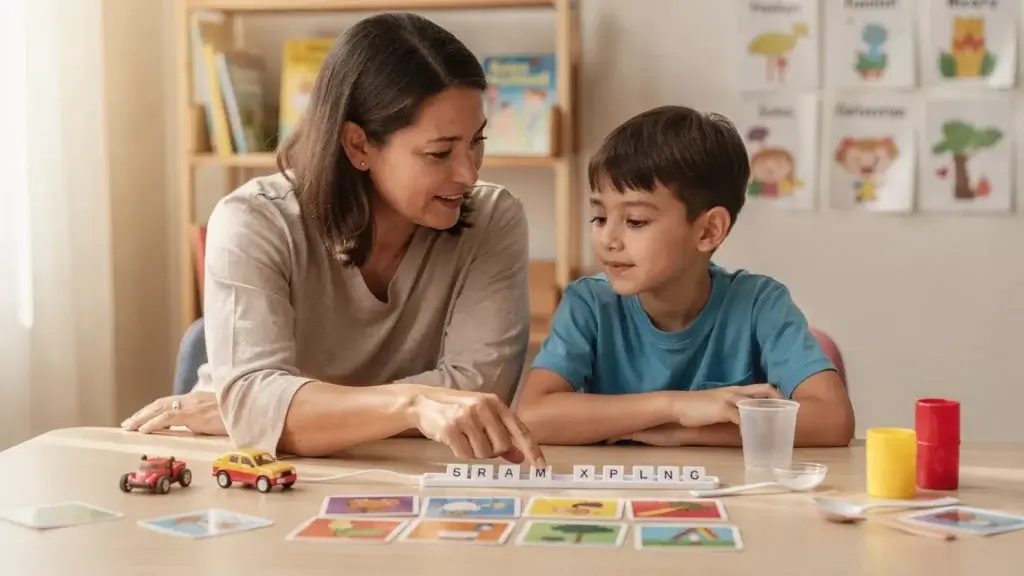
Building vocabulary is not just about learning “more words.” It is about learning the right words, understanding what they mean, and using them in flexible sentence structures so a child (or adult) can explain ideas, ask for help, learn at school, and connect socially.
The most effective language therapy activities do two things at the same time:
- Increase word knowledge (nouns, verbs, adjectives, concepts)
- Strengthen sentence building (grammar, word order, describing, storytelling)
Below are practical, evidence-informed activities you can use at home, in classrooms, or in therapy sessions to build vocabulary and sentences in a structured way.
Table of Contents
ToggleWhat makes an activity “language therapy” (not just “talking”)?
A true language-building activity has a clear target and a clear way to respond.
For example, “play with cars” can be great, but it becomes a language therapy activity when you intentionally target:
- Vocabulary: go, stop, crash, fast, slow, under, behind
- Sentence length: “Car go,” then “The car is going fast,” then “The blue car is going fast under the bridge.”
- Grammar: plurals (cars), prepositions (under/behind), past tense (crashed)
Speech-language pathologists often use strategies like modeling, recasting, and expanding to build longer and more accurate sentences during everyday communication. (For an overview of evidence-based language intervention approaches, see the American Speech-Language-Hearing Association (ASHA).)
Quick guide: how to choose the right activity for your child (or patient)
Before picking activities, identify what is currently hard:
- Receptive language (understanding): following directions, answering WH-questions, learning new concepts
- Expressive language (using words): naming, describing, word finding, using verbs, combining words
- Sentence structure: short phrases only, grammar errors, difficulty telling stories
Then choose one activity and adjust it to the right level.
How to “grade” any activity up or down
If it’s too hard, try this | If it’s too easy, try this |
Offer choices (“Do you want apple or banana?”) | Ask for 2 details (“Tell me what it is and what it does.”) |
Model first, then prompt | Add a reason (“Why?”) |
Use visuals (pictures, objects, gestures) | Add a story element (beginning, middle, end) |
Accept 1 to 2-word responses | Require a full sentence with a target grammar form |
Language therapy activities to build vocabulary and sentences
1) Daily routine narration (best for toddlers through early elementary)
This is one of the highest impact ways to build vocabulary because it is repeated every day.
Pick one routine (bath, meals, getting dressed) and “narrate” using short, clear sentences.
Examples:
- “Sock on.” then “Put the sock on your foot.” then “Put the striped sock on your left foot.”
- “Wash hands.” then “Wash your hands with soap.” then “Wash your hands before we eat.”
To turn it into sentence practice, intentionally repeat one structure all week, such as:
- Agent + action: “Mommy cuts,” “You stir,” “The water splashes”
- Action + object: “Cut the apple,” “Open the door”
2) The “one up” expansion game (classic therapy technique)
This activity is simple and powerful: whatever the learner says, you add one piece of language.
- Child: “Dog.”
- Adult: “Big dog.”
- Child: “Big dog.”
- Adult: “Big dog running.”
- Child: “Big dog running.”
- Adult: “The big dog is running fast.”
This keeps the interaction positive and reduces pressure, which is especially helpful for children who shut down when corrected.
3) Picture description with a sentence strip (vocabulary plus grammar)
Use any photo (family pictures, magazine pictures, printed images). Ask the learner to describe it using a predictable sentence pattern.
Helpful sentence starters:
- “I see a ___.”
- “The ___ is ___ing.”
- “The ___ is ___ (adjective).”
- “The ___ is ___ (preposition) the ___.”
You can rotate targets weekly (verbs one week, adjectives the next).
For a structured version of this approach, you may also like Bridges Speech Center’s explanation of Picture Talk in speech and language therapy.
4) Category sorting (strong vocabulary organizer)
Category knowledge supports word retrieval, comprehension, and later academic skills.
Use household items or picture cards and sort into categories:
- Food, clothes, animals, transportation
- Things you wear, things you eat, things you play with
- Big vs small, hot vs cold, wet vs dry
Once sorted, build sentences:
- “An apple is a fruit.”
- “We wear socks on our feet.”
- “A bus and a car are vehicles.”
To level up, add “because”:
- “A jacket is clothing because you wear it.”
5) “Barrier games” for longer sentences (great for preschool and school-age)
A barrier game means two people have similar materials, but they cannot see each other’s work (use a folder or book as a barrier). One person gives directions, the other follows.
Examples:
- Build the same Lego structure
- Draw the same simple picture
- Place stickers on a page based on directions
This naturally targets:
- Prepositions (under, next to, between)
- Size and color adjectives
- Sequencing words (first, then, last)
- Clear sentence structure
If a learner gives vague directions (“Put it there”), model a clearer sentence and have them try again.
6) Shared book reading with “WH” and retell (best for vocabulary depth)
Reading is not just for literacy, it is excellent for teaching less common vocabulary (e.g., enormous, worried, investigate) and for building narrative sentences.
A simple structure:
- Before reading: “What do you think will happen?”
- During reading: pick 3 target words, define simply, act them out
- After reading: retell using 3 to 5 sentence frames
Retell sentence frames:
- “At the beginning, ___.”
- “Then ___.”
- “The problem was ___.”
- “In the end, ___.”
For children who need more support, use pictures from the book as a visual sequence.
7) Sentence combining (school-age and teens)
Some learners know vocabulary but struggle to write or say more complex sentences. Sentence combining teaches how to join ideas.
Start with two short sentences and combine them.
Examples:
- “The boy ran. The boy was late.”
- “The boy ran because he was late.”
- “I saw a dog. The dog was brown.”
- “I saw a brown dog.”
This supports both expressive language and academic writing.
8) “Odd one out” and explaining (vocabulary plus reasoning)
Give 3 to 4 words or pictures and ask which does not belong and why.
- Apple, banana, carrot, orange
- “Carrot is the odd one out because it is a vegetable.”
This builds:
- Category vocabulary
- Sentence structure with “because”
- Higher-level language for classroom participation
9) Functional scripts for real life sentences (especially helpful for autistic learners and adults)
Scripts are short, practiced phrases for predictable situations. They can reduce anxiety and increase independence.
Common script targets:
- Requesting help: “Excuse me, can you help me with ___?”
- Ordering food: “I would like ___, please.”
- Repairing breakdowns: “I don’t understand, can you say it again?”
Practice the script in role play, then use it in the real context.
10) Activities for adults rebuilding language (aphasia, TBI, dementia support)
Vocabulary and sentence work applies to adults too, but goals are often more functional.
Examples of therapy-style activities:
- Word finding with categories: name 5 items in “kitchen,” then use each in a sentence
- Photo-based conversation: describe a personal photo using “who, what, where, when”
- Script training: practice key sentences for phone calls, medical visits, or work
If you are supporting a loved one after stroke or brain injury, structured support can make practice safer and more effective. Bridges Speech Center also shares how speech therapy fits into recovery in their stroke rehabilitation guide.
A simple way to track progress (so you know the activity is working)
Progress is easier to notice when you track one small metric for 2 to 4 weeks.
Target skill | What to track at home | Example goal |
Vocabulary | Number of new words used independently | Uses 10 new verbs in daily routines |
Sentence length | Average words per sentence in a 5-minute sample | Moves from 2-word to 4-word sentences |
Grammar | Accuracy of one form (plural -s, past tense -ed) | Uses plurals correctly in 8/10 tries |
Storytelling | Retell with beginning, middle, end | Retells 3 events in order |
If progress is flat for several weeks, it can mean the target is too hard, the prompts need adjusting, or an underlying issue (hearing, attention, motor speech, comprehension) needs assessment.
Tips for multilingual families in Dubai
Many children in Dubai hear more than one language. Multilingualism itself does not cause language disorder, but it can change what “typical” looks like.
Practical guidance:
- Use the language you are most comfortable speaking when teaching new concepts
- Repeat targets across both languages when possible (same concept, different word)
- Focus on functional sentences used daily at home and school
If you are unsure what is expected for your child’s age, you can compare skills to typical development ranges and discuss concerns with a licensed speech-language pathologist.
When to seek professional support
Consider an evaluation if you notice:
- Limited words or very short phrases compared to peers
- Difficulty following directions or answering simple questions
- Frequent frustration, shutdowns, or behavior linked to communication
- Little progress despite consistent practice
A speech-language therapist can identify whether the main need is vocabulary growth, sentence structure, comprehension, speech clarity, or a combination.
To understand what a speech-language therapist does across ages and needs, see Speech and Language Therapist roles and responsibilities.
Get a personalized language plan at Bridges Speech Center (Dubai)
Activities work best when they match the learner’s exact profile, including comprehension level, attention, speech clarity, and confidence. If you would like a tailored plan, Bridges Speech Center in Dubai provides individualized speech and language therapy for children and adults, with options for clinic sessions, speech therapy at home, and telehealth.
Explore services at Bridges Speech Center or contact the team at +971-505226054 to book an assessment and get clear next steps.
Frequently Asked Questions
What are the best language therapy activities for vocabulary?
Daily routine narration, category sorting, shared book reading, and picture description are strong starting points because they repeat words in meaningful contexts.
How do I help my child move from single words to sentences?
Use consistent modeling and the “one up” expansion strategy. Accept the child’s word, then add one more word (or one grammar piece) and repeat it naturally.
How long should we practice language therapy activities each day?
For most families, 10 to 15 minutes of focused practice plus language-rich routines (meals, bath, play) is more sustainable than long drills.
.
Can these activities help adults after stroke or brain injury?
Yes. Adults often benefit from functional vocabulary work, photo-based conversation practice, and script training for daily life situations. A personalized plan is important.
Do language therapy activities work for autistic children?
They can, especially when activities are structured, motivating, and paired with functional communication goals (requests, commenting, turn-taking). Visual supports and predictable routines often help