
Understanding CME Therapy
Families often ask for a physiotherapy approach that builds real-world strength and balance for children who struggle with sitting, standing or walking. CME therapy answers that need with a structured, play-like method that activates a child’s natural postural reactions and helps the body learn to move against gravity. At Bridges Speech Center in Dubai, our pediatric team integrates CME therapy with family coaching so progress carries over to home, school and the community.
What is CME therapy?
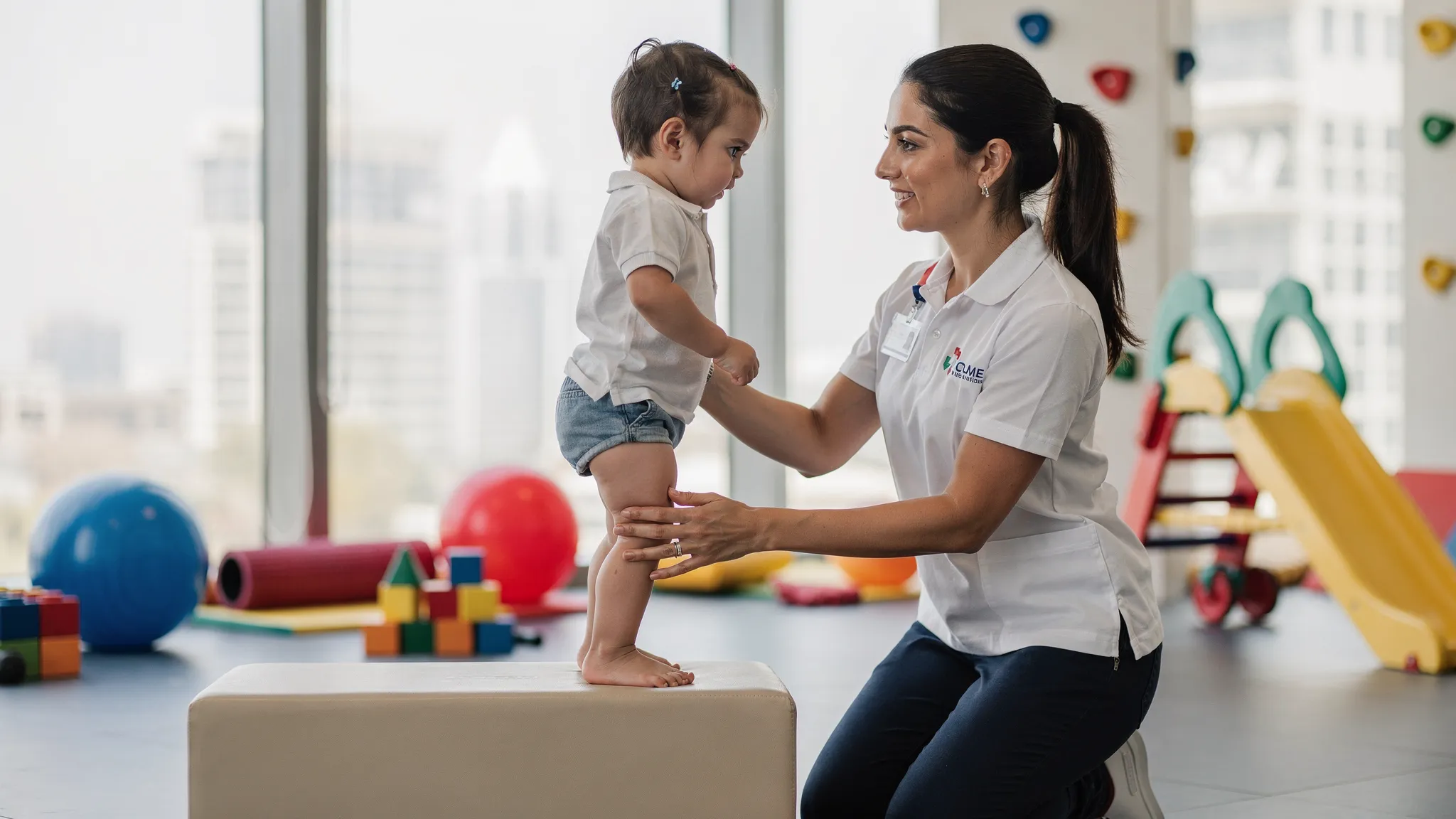
CME therapy stands for Cuevas Medek Exercises, a specialized pediatric physiotherapy approach created to help children with motor delays develop automatic balance and functional movement. Instead of holding a child at the trunk, the therapist provides minimal distal support, then uses graded challenges so the nervous system learns to control posture without heavy assistance.
This makes CME therapy different from approaches that rely on prolonged support or passive stretching. The method emphasizes gravity-based challenges, repeated practice and precise progression. If you want to explore how sessions look in our clinic, learn more about CME therapy.
Parents may also see the term cme physical therapy, which refers to the same Cuevas Medek Exercises delivered by licensed physiotherapists with specialized training.
Who can benefit from CME therapy?
Children who show some active movement, yet struggle to reach motor milestones, often respond well to CME therapy. It is commonly used for children with:
- Cerebral palsy with motor delay
- Hypotonia or low muscle tone
- Developmental coordination disorder
- Genetic syndromes such as Down syndrome
- Prematurity-related motor delays
- Neuromuscular conditions under a pediatric physio plan
If you are comparing options across Dubai, you can also review our broader pediatric physiotherapy programs to understand how CME fits into a comprehensive plan.
How CME therapy works
CME therapy was designed around five core principles that help kids learn faster and retain skills:
- Task specificity, every exercise maps to a functional goal like sitting, standing, transitions or stepping
- Distal support, the therapist holds farther from the body, usually at legs or feet, to encourage the torso to do more work
- Graded exposure to gravity, positions and equipment are chosen to safely challenge balance reactions
- High repetition and intensity, short sets repeated with minimal rest to build motor patterns
- Measurable progression, supports are reduced and difficulty is increased as reactions improve
CME therapy compared with common pediatric physio models
| Feature | CME therapy | Traditional pediatric PT | NDT style handling |
|---|---|---|---|
| Therapist support | Distal support at legs or feet, minimal trunk hold | Varies by goal, often more proximal support | Emphasis on guided handling to shape movement |
| Primary stimulus | Gravity challenge to trigger automatic balance | Exercise plus play-based practice | Hands-on facilitation and alignment |
| Session focus | Elicit postural reactions during functional tasks | Strength, range, balance and motor learning | Quality of movement patterns |
| Progression | Reduce support, increase challenge | Progressive loading and skill complexity | Fading of manual cues over time |
| Home carryover | Short, specific drills that mirror clinic tasks | Home exercise program by goals | Practice of facilitated patterns with caregiver |
All three can be effective when matched to a child’s profile. Many families choose a blended plan where CME therapy is the engine for balance and standing progress, supported by strength and mobility work.
What happens in a CME therapy session
A typical 45 to 60 minute session includes:
- Brief check-in and movement screen, updates on sleep, shoes and braces
- Warm-up with easy balance tasks to prime reactions
- A series of CME exercises, for example supported stands from a low bench, step-ups to a foam block, hands-free kneeling transitions
- Measured rest for safety, then repetition with small changes in height or surface
- Cooldown with active range and breathing
- Parent coaching so at-home practice is consistent
Across sessions your therapist will reduce the level of support and increase challenge only when your child shows safe, repeatable reactions. This is how CME therapy builds durable skills.
What outcomes can parents track?
Objective measures help everyone see progress:
- Sitting balance time with hands free
- Independent transitions, belly to sit, sit to stand from a low bench
- Standing duration and step initiation
- Stair practice with hand support then without
- GMFM scores if appropriate, many clinics use the Gross Motor Function Measure to track change
Short videos of the same tasks each month are great for comparing posture, endurance and confidence.
CME therapy in Dubai, finding the right team
Training and safety matter for this method. Ask about a therapist’s CME coursework, pediatric hours and how they set home programs. At Bridges Speech Center your child’s plan is led by pediatric physiotherapists and integrated with occupational, feeding and speech therapy when needed. For families searching specifically for cme therapy dubai, our clinicians can outline a plan during the first visit and show how we will measure change.
- Learn about our local approach to CME therapy Dubai
- Explore comprehensive pediatric physiotherapy in Dubai that complements CME exercises
- If your child also needs help with articulation or language, see Speech therapy Dubai to coordinate schedules
Families who prefer home-based plans can ask for adapted CME home drills as part of cme physical therapy dubai, then follow up in the clinic to progress the difficulty safely.
A simple 12 week roadmap to get started
Every child is different, though many see a pattern like this when therapy is consistent.
- Weeks 1 to 4, build the routine. Focus on comfortable standing frames, assisted transitions and early step reactions. Expect small wins like longer hands-free sitting and improved head control in kneeling.
- Weeks 5 to 8, progress difficulty. Add unstable surfaces like foam blocks, raise support points lower on the legs, introduce step-ups to targets. Celebrate first partial stands or a few independent steps if this is the goal.
- Weeks 9 to 12, consolidate and generalize. Practice the same reactions in new places, school, playground, home. Fade cues and expand endurance with short circuits.
Your therapist will adjust frequency based on response. Many families start with two sessions per week and a short daily home set.
Home program tips that fit real life
- Keep drills short, two to three sets of 30 to 60 seconds per task
- Use sturdy furniture, a low bench and a textured mat for traction
- Film the first clinic demonstration so you can match the hold and timing
- Attach practice to routines, after breakfast, just before nap, after school
Safety, comfort and when to pause
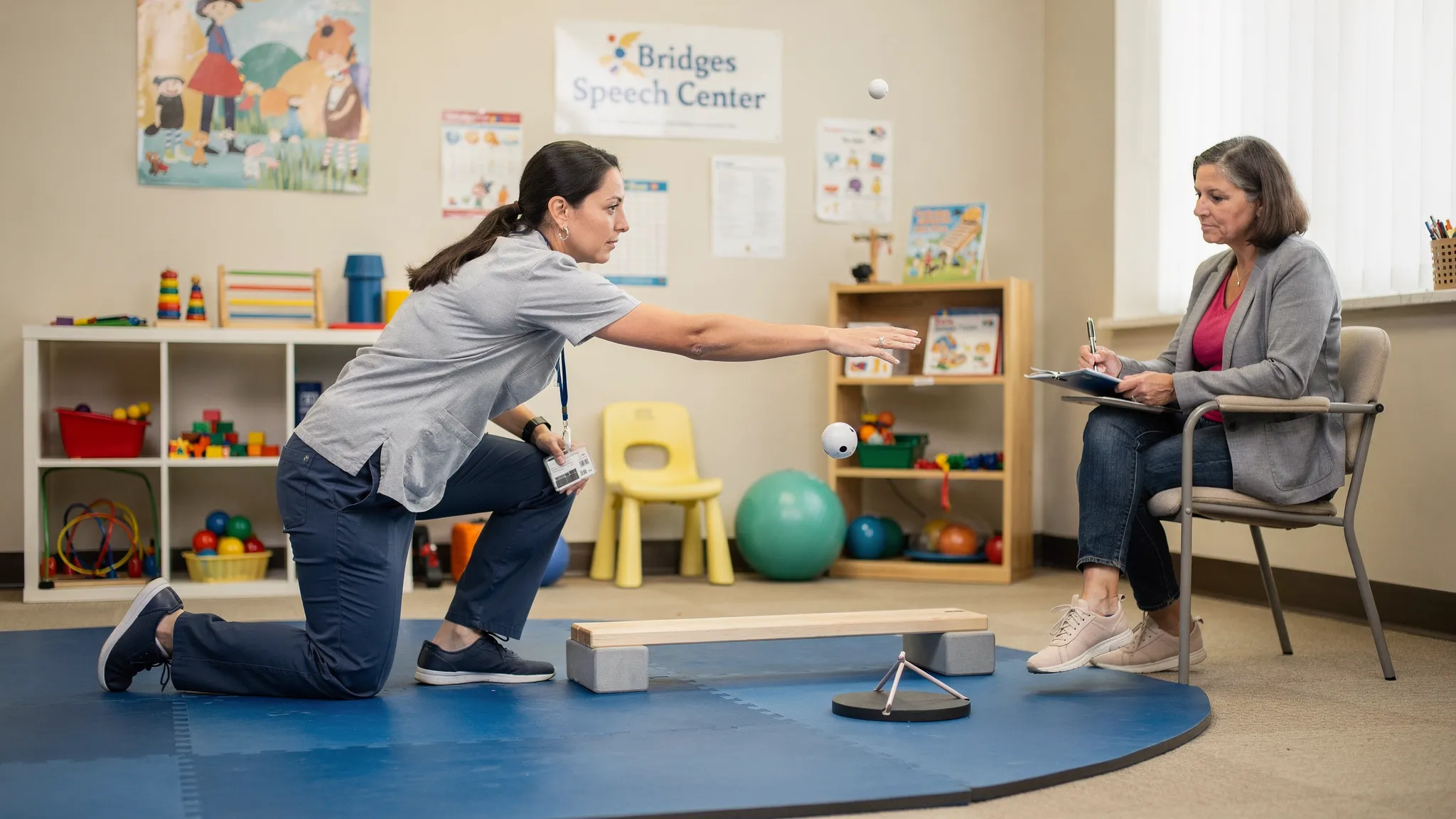
Sessions should feel challenging yet safe. Tell your therapist about pain, unusual fatigue or changes in medical status. Children with uncontrolled seizures, recent fractures or acute illness may need to pause. Shoe choice can affect balance, bring everyday shoes so practice matches real life.
Why choose Bridges Speech Center
Bridges Speech Center combines CME therapy with targeted strength work, sensory integration and caregiver coaching so progress is meaningful at home and school. We coordinate with teachers and physicians, create simple tracking sheets and share monthly video comparisons. If your child also needs language goals, our team can align speech therapy and pediatric physiotherapy visits to reduce travel and boost consistency. Many families describe this as cme physical therapy managed as part of a full developmental plan.
Ready to begin?
If you are exploring cme therapy dubai for your child, we would love to help. Book an evaluation for CME therapy Dubai or learn about related services like pediatric physiotherapy and Speech therapy Dubai. You can also call Bridges Speech Center at +971-505226054 or 043581115 to speak with our team.
Conclusion
CME therapy is a focused, evidence-informed way to help children unlock balance and movement against gravity. By using distal support, task-specific goals and measured progression, it teaches the nervous system to do more with less help. When combined with a family-friendly home program and coordinated care, children often achieve steadier sitting, stronger standing and more confident steps. Bridges Speech Center delivers CME therapy within a multidisciplinary plan so gains are visible in everyday life. Reach out to schedule your child’s first session.
Frequently Asked Questions
What makes CME therapy different from other pediatric physio methods?
CME therapy uses distal support and gravity-based challenges to trigger automatic balance reactions rather than relying on prolonged trunk hold.
How often should my child attend CME therapy?
Many children start with two sessions per week plus a short daily home routine, then adjust based on progress and endurance.
Is cme physical therapy suitable for hypotonia or Down syndrome?
Yes, clinicians often use Cuevas Medek Exercises for children with hypotonia or Down syndrome when the child can tolerate brief upright challenges.
Can we do CME therapy at home in Dubai?
Home drills are part of care, though new or harder challenges should be introduced in the clinic for safety. Ask your therapist how to set up a simple space at home.
How soon will we see results with cme therapy?
Some families notice better sitting balance or faster transitions in a few weeks, while walking goals can take longer. Consistency with clinic sessions and home practice speeds progress.
CME therapy uses distal support and gravity-based challenges to trigger automatic balance reactions rather than relying on prolonged trunk hold.
Many children start with two sessions per week plus a short daily home routine, then adjust based on progress and endurance.
Yes, clinicians often use Cuevas Medek Exercises for children with hypotonia or Down syndrome when the child can tolerate brief upright challenges.
Home drills are part of care, though new or harder challenges should be introduced in the clinic for safety. Ask your therapist how to set up a simple space at home.
Some families notice better sitting balance or faster transitions in a few weeks, while walking goals can take longer. Consistency with clinic sessions and home practice speeds progress.