

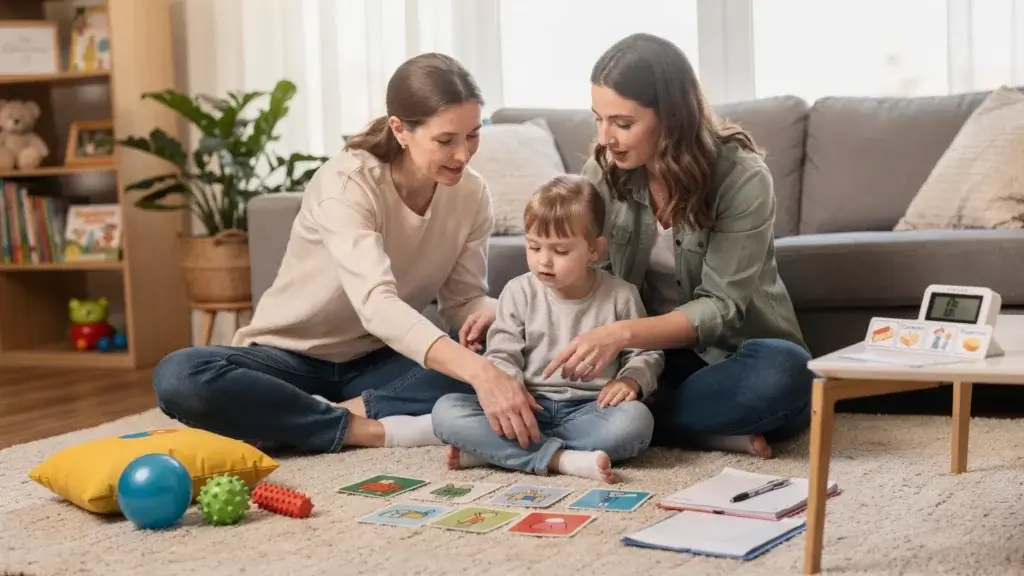
Autism support does not only happen inside a clinic. For many families in Dubai, real progress is built in everyday moments, at breakfast, during play, on the way to school, and before bedtime. Autism therapy at home works best when it is structured, consistent, and connected to meaningful daily routines.
In this guide, you will learn what autism therapy at home can look like, how to set it up safely, which skills to target first, and how to combine home practice with professional support from Bridges Speech Center and a multidisciplinary team.
Table of Contents
ToggleWhat does autism therapy at home mean in real life?
Autism therapy at home is a practical plan that brings therapy goals into the environment where a child spends most of their time. It may include home visits from therapists, parent coaching, telehealth sessions, and simple home programs designed to build communication, independence, and regulation.
Home-based support is not about turning parents into full-time therapists. It is about helping families use evidence-informed strategies in short bursts across the day so the child practices skills in real contexts.
At Bridges Speech Center, families often combine clinic sessions with home support, depending on the child’s needs, attention, sensory profile, school schedule, and family routine.
Why many families choose autism therapy at home
Autism therapy at home can be powerful because it improves carryover. Skills that are practiced only in a therapy room may not automatically show up at home, in the car, or in public.
Here are common reasons families prefer home-based autism intervention:
- The child is more comfortable in a familiar space which can reduce anxiety and shutdowns.
- Parents can learn strategies to live with real routines like mealtimes, toileting, play, and transitions.
- Therapists can observe the environment and suggest realistic adjustments.
- Practice becomes easier to repeat every day which supports habit building.
If your child struggles with transitions, meltdowns, or communication breakdowns mostly at home, autism therapy at home lets the therapist target the real situation instead of an imagined one.
Who can benefit from autism therapy at home?
Autism therapy at home can support toddlers, school-age children, teens, and in some cases adults, especially when goals relate to daily functioning.
It is often helpful when a child:
- Has limited joint attention, imitation, or early play skills
- Has delayed language or uses scripts without flexible communication
- Has sensory processing challenges that affect sleep, feeding, dressing, or focus
- Shows intense rigidity, distress with change, or frequent transitions difficulties
- Needs support generalizing skills from therapy to family life
It can also be effective when the family wants coaching that fits their culture, home language, and daily schedule.
Core areas to target in autism therapy at home
A good home program focuses on skills that improve daily life, not isolated tasks. Most home plans fall into a few core categories.
1) Communication goals (speech, language, AAC)
Many children need support with functional communication, not only speech sounds. Home sessions often target requesting, refusal, asking for help, answering simple questions, and social turn-taking.
For families looking for speech therapy Dubai services that connect directly to daily routines, Bridges Speech Center provides speech therapy with parent involvement and individualized planning.
If you are exploring professional in-home options, this resource on speech therapy at home explains what sessions can look like and how to prepare.
2) Social interaction and play
Play is not just entertainment. It is where children learn shared attention, flexible thinking, and early conversation patterns.
In autism therapy at home, therapists often coach parents to:
- Follow the child’s lead in play then add one small variation
- Build short back-and-forth turns using toys, bubbles, blocks, or pretend food
- Use simple predictable phrases then pause to create communication opportunities
This approach aligns with naturalistic strategies used in many evidence-based early interventions.
3) Sensory regulation and daily routines
Many autistic children experience sensory overload, sensory seeking, or difficulty filtering input. This can affect morning routines, grooming, clothing tolerance, homework, and sleep.
A sensory-informed plan may include movement breaks, calming corner routines, predictable transitions, and proactive regulation strategies. Bridges offers in-home support guidance in sensory integration therapy at home for families who want simple routines that are safe and practical.
If you are also considering occupational therapy Dubai services, home programs can be especially useful for dressing, handwriting readiness, fine motor play, and independence skills.
4) Behavior support and emotional regulation
Behavior is communication. In autism therapy at home, the goal is not to “stop” behavior without understanding it. The goal is to identify the function and teach a replacement skill.
Many home plans include:
- Visual schedules to reduce uncertainty
- Choice boards to increase cooperation
- Functional communication training such as “break” “help” “all done”
- Calm routines that the child practices before they are overwhelmed
When needed, a behavior plan can also be supported by ABA principles and psychotherapy or CBT strategies, especially when anxiety is part of the picture.
5) Feeding and mealtime participation
Some children need feeding therapy due to sensory-based food refusal, oral motor challenges, or rigid mealtime routines. Home carryover matters because meals happen at home. If feeding is a concern, ask your team how feeding goals connect with communication, sensory needs, and behavior support.
A simple home routine plan you can start this week
Many families succeed when they stop chasing long sessions and start building short daily repetitions. A realistic target is 10 to 20 minutes total per day, spread across routines.
Below is an example of how autism therapy at home can be organized without overwhelming the family.
Daily moment | Therapy focus | Example activity at home | How long |
Breakfast or snack | Functional communication | Offer a choice of two items, wait for a point, word, sign, or AAC then model “I want juice” | 3 to 5 min |
Play time | Joint attention and turn-taking | Roll a ball back and forth, pause for eye contact or gesture before the next turn | 5 min |
Transition to bath or bedtime | Regulation and predictability | Use a 3-step visual schedule, give a 2-minute warning, offer a calming sensory routine | 3 to 5 min |
Story time | Language and comprehension | Use simple WH questions, point to pictures, model 1 to 2 word expansions | 5 min |
Consistency is more important than intensity. If you can repeat the same structure daily, you are building a learning pathway that supports generalization.
How to set up your home environment for success
The best setup is simple. Autism therapy at home does not require expensive equipment. Start with clarity, structure, and fewer distractions.
Create a “communication friendly” space
Choose one small area with:
- A small table or floor mat
- A box of preferred toys
- A visual schedule or first then board
- A place for AAC or picture cards if your child uses them
Keep sessions short then end on success. Stopping while things are going well builds motivation for the next time.
Use visual supports for predictability
Many autistic children process visual information more easily than long spoken explanations. Visual schedules help reduce repeated prompting and reduce conflict.
Track progress in a parent-friendly way
In autism therapy at home, progress tracking can be simple. Pick one measurable target per week.
Examples:
- “Requested help 3 times per day using word, gesture, or AAC”
- “Tolerated toothbrushing for 30 seconds with a timer”
- “Completed one transition using first then without crying”
A therapist can help you choose goals that are realistic and functional.
Latest trends in autism therapy at home in 2026
Home-based care is evolving quickly. Here are trends families in Dubai are asking about more often in 2026.
Parent coaching as a primary treatment tool
Instead of relying only on child-only sessions, many programs now prioritize coaching because parents can deliver dozens of learning moments every day. This makes autism therapy at home more sustainable.
Hybrid care models
More families use a blend of clinic sessions, home visits, and telehealth. Hybrid plans support continuity during travel, school terms, or busy weeks. They also help when a child needs time to feel comfortable with new therapists.
Earlier support for AAC and functional communication
AAC is increasingly introduced earlier when speech is limited or inconsistent. The goal is to reduce frustration and increase interaction. AAC does not prevent speech, for many children it supports language development when implemented well by a qualified team.
Data-informed therapy planning
Families want clearer outcome tracking. More clinicians now use simple data tools, video review, and home logs to adjust goals based on what is actually improving.
If you want to work with a qualified speech pathologist Dubai families trust, Bridges Speech Center shares what to look for in professional expertise and scope through their speech therapist team.
When should you get professional support?
Home practice is valuable, but it should not replace proper assessment when concerns are significant. Seek support if:
- Your child is not using gestures, words, or AAC consistently to communicate needs
- Meltdowns are frequent and hard to predict
- Feeding is restricted to very few foods or mealtimes are highly stressful
- Sensory challenges limit daily activities like dressing, school attendance, or sleep
- You are unsure what to target first
At Bridges Speech Center, families can combine autism therapy at home with clinic support so goals stay coordinated across speech, OT, behavior therapy, feeding support, physiotherapy, and psychology.
To understand how daily living skills can be targeted in real contexts, you can also explore occupational therapy at home as part of a combined plan.
For parents specifically searching for speech therapy Dubai options with a coordinated multidisciplinary approach, start with Speech therapy Dubai services and discuss whether a home care format fits your child’s needs.
Conclusion: making autism therapy at home work for your family
Autism therapy at home works best when it is simple, consistent, and built around real routines. Focus on functional communication, play, regulation, and independence. Use visuals, short practice moments, and clear goals. Most importantly, do not do it alone.
Bridges Speech Center supports families with individualized plans that can include autism therapy at home, clinic sessions, and telehealth, alongside speech therapy, occupational therapy, feeding therapy, ABA support, and psychological services.