
After a hearing screening, an ENT appointment, or even a note from school, parents suddenly start hearing a lot of therapy terms. Two that come up again and again are Auditory Verbal Therapy and speech therapy. They sound similar at first. Both are about communication. Both involve working with a professional. So it’s easy to assume they’re basically the same thing. They’re not.
Understanding the difference between Auditory Verbal Therapy and speech therapy can actually save you time and confusion. Especially in the early years. That’s when the brain is most ready to build listening and language skills. Waiting too long or choosing the wrong focus can slow things down without anyone meaning to.
Table of Contents
ToggleWhy does this comparison matter so much?
Because once you know your child needs support, the real question is usually not “Do we need therapy?” It’s more like, “Where do we even start?”
For many children with hearing loss, the biggest hurdle is not pronunciation. It’s access to sound. It’s learning to notice sound, attach meaning to it, and slowly build language through listening. That’s a very specific process.
For other children, the issue may be different. Maybe their hearing is fine, but their speech sounds are unclear. Or their language is delayed. Or they struggle with fluency or social communication. In those cases, the focus shifts.
So comparing Auditory Verbal Therapy and speech therapy isn’t about deciding which one is better. It’s about understanding what each one is actually designed to do, who it fits best, and how much parents are expected to be involved. Once that becomes clear, the next step usually feels a little less overwhelming.
So what is Auditory Verbal Therapy, really?
In simple terms, AVT is a therapy approach designed for children with hearing loss. The main idea is this: help the child learn to listen first, and then build spoken language from that listening. Hearing becomes the main pathway for communication, not visual cues or sign support.
AVT usually works hand in hand with hearing technology like hearing aids or cochlear implants. And it’s not a one time setup. There has to be regular audiology follow up to make sure the devices are working properly and giving the child consistent access to sound. Without that, the therapy cannot do much.
In sessions, the focus is very specific. The child is guided to first notice sounds. Then tell the difference between sounds. Then recognize what those sounds mean. And slowly, over time, understand and use spoken language. It’s step by step. Sometimes progress feels small, but those small listening skills add up.
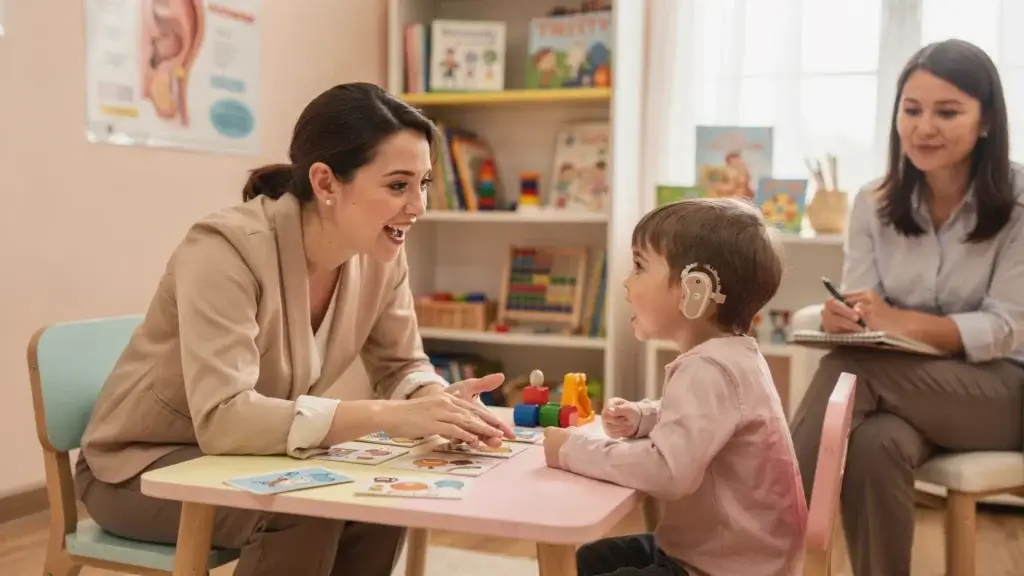
When parents ask, “What is Auditory Verbal Therapy?” they’re usually also wondering what they are supposed to do. And that’s a big part of it. AVT is not just the therapist working with the child while the parent waits outside. Parents are actively coached. They learn how to turn everyday moments, like mealtime or bath time or a car ride, into listening opportunities.
So practice does not happen only during the session. It carries into daily life. And that consistency is kind of the whole point.
What is speech therapy?
Speech therapy is provided by a speech-language pathologist (SLP). It targets communication skills across speech, language and related areas such as voice, feeding and swallowing or social communication depending on the person’s needs.
Speech therapy can support children, teens and adults. It may focus on articulation, phonology, expressive language, receptive language, stuttering or voice. It can also be part of speech therapy for hearing loss when the goal is clearer speech, stronger language skills or better communication strategies.
If you are exploring options in Dubai, you can learn more about Speech therapy Dubai services at Bridges Speech Center.
Auditory Verbal Therapy vs Speech Therapy at a glance
The clearest way to understand Auditory Verbal Therapy vs Speech Therapy is to compare the main targets and the typical client profile.
Area | Auditory Verbal Therapy (AVT) | Speech Therapy |
Primary focus | Listening skills and spoken language through hearing | Speech clarity, language skills and functional communication goals |
Typical candidates | Children with hearing loss using hearing aids or cochlear implants | Children and adults with a wide range of speech and language needs including hearing loss |
Core techniques | Auditory first strategies, listening checks, parent coaching, routine based practice | Articulation therapy, language intervention, fluency work, voice therapy, AAC support when needed |
Parent role | Very high involvement, caregiver coached in-session | Often involved, varies by age and goal |
Best fit goal | Build listening and spoken language as the primary communication mode | Improve communication effectiveness in the areas affecting daily life |
This table does not mean one is better. It means they are designed for different primary problems.
How AVT supports early intervention for hearing loss
Early intervention for hearing loss is a time sensitive window. The goal is not only to “hear sounds” but to develop the brain’s ability to process sound into language.
In AVT sessions the therapist typically:
- Checks listening access with the child’s hearing technology and daily routines for device use
- Builds auditory attention and sound awareness
- Teaches parents how to create listening opportunities during play, meals, bath time and story time
- Expands spoken vocabulary, grammar and conversation skills through listening based activities
If you are specifically looking for Auditory verbal therapy in Dubai, Bridges Speech Center supports families with listening focused programs and caregiver training.
How speech therapy for hearing loss can look different
Families sometimes assume AVT is the only therapy that helps children with hearing loss. In practice, speech therapy for hearing loss can be essential, especially when a child:
- Has delayed speech sound development even with good access to sound
- Needs explicit articulation placement cues
- Has language gaps in vocabulary, grammar or narrative skills
- Needs support for social communication in school settings
In these cases, speech therapy for hearing loss may work on clarity, sentence structure, storytelling and conversation repair strategies.
Speech therapy can also be critical for older children who were identified later or who use multiple communication modes. It can support functional goals even when listening skills are still developing.
To understand what qualified clinicians do across ages and conditions, see Bridges Speech Center’s overview of a Speech therapist.
Which approach does my child need?
This is the decision point most families are really trying to solve when they search Auditory Verbal Therapy vs Speech Therapy.
Is the main barrier to access to sound or speech and language skills?
If hearing loss is the main driver of the delay and your child is using hearing aids or a cochlear implant, AVT may be a strong match because it directly targets listening development.
If your child hears well enough for learning spoken language but struggles with speech clarity, language structure or fluency, speech therapy may be the primary fit.
Many children benefit from both over time. The starting point depends on the assessment.
How old is my child and how early did we start?
Early intervention for hearing loss often makes the biggest difference in long term listening and spoken language outcomes. The earlier a child receives appropriate hearing technology and therapy, the more opportunities they have to build listening skills in real life.
If you want a broader view of why timing matters in communication development, read Bridges Speech Center’s guide on the importance of early intervention in speech and language development.
Does my child have additional needs?
Some children with hearing loss also have motor planning challenges, attention differences or developmental conditions. In those cases, a combined plan may be recommended. A child could work on listening skills through AVT while also receiving targeted speech sound work or language therapy.
If your child is receiving services, make sure all professionals align on shared goals so practice is consistent across home and school.
Can Auditory Verbal Therapy and speech therapy be combined?
Yes. The comparison Auditory Verbal Therapy vs Speech Therapy is not always an either-or choice.
A combined plan may look like:
- AVT to strengthen listening as the foundation for spoken language
- Speech therapy to address specific speech sounds, phonology or language organization
- Parent training to help strategies generalize beyond the clinic
For younger learners, families often start with listening and spoken language targets then add specific speech sound goals as the child’s auditory skills stabilize.
Parents looking for pediatric services can explore speech therapy for kids in Dubai through Bridges Speech Center.
What happens in an evaluation?
A good evaluation for a child with suspected or confirmed hearing loss should connect the dots between hearing access, listening behavior and communication skills.
Depending on your child’s history, a therapist may review:
- Hearing test results and medical history
- Current hearing technology use and daily wear time routines
- Listening skills in quiet and in noise
- Speech sound development and intelligibility
- Receptive and expressive language skills
- Functional communication at home, nursery or school
This assessment helps determine whether AVT, speech therapy or a combined plan best fits.
If you are starting therapy and need flexible delivery options, Bridges also offers guidance and services for speech therapy at home in Dubai.
Conclusion
The key difference in Auditory Verbal Therapy vs Speech Therapy is the primary target. AVT is designed to build listening and spoken language through hearing and it is often central to early intervention for hearing loss. Speech therapy addresses speech and language goals across many conditions and speech therapy for hearing loss can be highly effective when clarity, language structure or functional communication skills are the main concerns.
If you are unsure where to begin, a comprehensive assessment can clarify the best plan for your child or your family member. Bridges Speech Center in Dubai provides individualized programs across ages, including speech therapy services with parent involvement, clinic based support and home care options. To schedule an appointment, contact Bridges Speech Center
Frequently Asked Questions
Is Auditory Verbal Therapy the same as speech therapy?
No. Auditory Verbal Therapy focuses specifically on listening and spoken language development through hearing. Speech therapy will target speech, language, fluency and more.
What is auditory verbal therapy and who is it for?
AVT is typically for children with hearing loss who use hearing aids or cochlear implants and are building listening based spoken language.
Can speech therapy for hearing loss help after cochlear implantation?
Yes. Speech therapy for hearing loss can support articulation, language growth and communication strategies after cochlear implantation
Why is early intervention for hearing loss so important?
Early intervention for hearing loss supports the development of auditory pathways during early brain development. Starting early often improves access to spoken language learning in daily routines.
How do I choose between Auditory Verbal Therapy vs Speech Therapy in Dubai?
The decisions should be based on an assessment of hearing access, listening skills and communication goals. Many children benefit from a combined plan guided by experienced clinicians.